5 Best Automatic Cat Feeders
As an Amazon Associate, I earn from qualifying purchases. If you’re anything like me, you love your cat more than almost anything—except maybe your sleep. For years, I suffered through the 5:00 AM wake-up calls,...
As an Amazon Associate, I earn from qualifying purchases.
If you’re anything like me, you love your cat more than almost anything—except maybe your sleep. For years, I suffered through the 5:00 AM wake-up calls, complete with headbutts, insistent meowing, and the occasional paw to the face, all because my feline overlord decided breakfast was past due. That all changed when I finally invested in a high-quality automatic cat feeder. After testing dozens of models in my own home, navigating through app connectivity issues, jammed kibble, and clever cats breaking into food hoppers, I’ve compiled the definitive guide to the best automatic cat feeders available today.
In my experience, an automatic cat feeder isn’t just about convenience; it’s a vital tool for managing your cat’s health, ensuring strict portion control, and providing peace of mind when you’re stuck at work, caught in traffic, or away for the weekend. The right feeder will dispense precise amounts of food, maintain a reliable schedule even during power outages, and keep the food fresh and secure from determined paws. It transforms the dynamic between you and your cat—you are no longer the sole provider of food who must be harassed at dawn; the machine becomes the food source, allowing you to sleep in peace.
However, the market is currently flooded with hundreds of options, ranging from simple gravity bowls to highly complex, Wi-Fi-enabled smart devices that track every calorie your cat consumes. Navigating this landscape can be overwhelming. I have spent months putting these devices through rigorous testing. I’ve evaluated their build quality, their ability to withstand determined feline break-in attempts, the reliability of their scheduling mechanisms, and the ease of cleaning. I’ve also paid close attention to how well they handle different shapes and sizes of kibble, a critical factor that often leads to jams in lesser models.
Below, you will find my carefully curated list of the absolute best automatic cat feeders on the market, categorized to help you find the perfect fit for your specific lifestyle, budget, and your cat’s unique dietary needs. Whether you have a tech-savvy home, a multi-cat household with a notorious food thief, or simply need a reliable way to dispense wet food while you are at work, there is a solution here for you.
1. PETLIBRO Automatic Cat Feeder with Camera

In my experience, smart features on pet products can sometimes feel like a gimmick, but the PETLIBRO with its integrated camera is a genuine game-changer. After setting this up in my living room, I immediately appreciated the peace of mind it offered while I was away at the office. The video quality is surprisingly crisp, and the app integration is one of the smoothest I’ve encountered in the notoriously clunky pet tech space. It provides a comprehensive solution that goes beyond just feeding, offering a window into your pet’s daily life when you aren’t around.
Pros:
- Excellent 1080p HD camera with 145-degree wide-angle view and night vision
- Seamless smartphone app integration for intuitive scheduling and remote feeding
- Two-way audio allows you to speak to your cat and hear their response
- Reliable anti-clog design handles various kibble sizes effortlessly without jamming
- Dual power supply with battery backup ensures meals are served during power outages
Cons:
- Requires a stable 2.4GHz Wi-Fi connection; may struggle with some 5GHz-only routers
- The stainless steel bowl could be slightly larger for wider-faced cats prone to whisker fatigue
- Premium features come with a slightly higher learning curve for the initial setup process
When I rigorously tested the PETLIBRO, the very first thing that stood out was the exceptional build quality. It feels sturdy, weighty, and premium. The secure twist-lock lid is a massive upgrade from flimsy snap-on lids; it successfully thwarted my most food-motivated cat’s relentless attempts to break into the hopper. The 1080p camera is genuinely useful, not just a novelty. I found myself checking in frequently not just to verify that the food dispensed properly, but simply to say hello using the crisp two-way audio. The night vision is remarkably clear, allowing you to see whether your cat is actually eating during those midnight snacks or just investigating the kitchen.
One of the most impressive aspects of this unit is its unfailing reliability. During a brief internet and power outage at my house caused by a severe storm, the feeder seamlessly transitioned to battery power. It continued to dispense meals perfectly on schedule thanks to its internal memory and the dual-power supply (plug-in AC adapter with alkaline battery backup). The patented anti-clogging mechanism hasn’t failed me a single time, easily handling the irregularly shaped, larger dental kibble my veterinarian recommended, which had previously jammed other machines.
While the initial setup can be slightly finicky if you have a complex mesh router system (it strongly prefers a dedicated 2.4GHz network for the initial handshake), once connected, the PETLIBRO app is an absolute joy to use. The user interface is clean and responsive. You can set highly customized feeding schedules, adjusting the portion size for each individual meal. You can also record personal voice messages up to 10 seconds long to play at mealtime, and receive detailed push notifications when meals are served, if the food hopper is running low, or if a blockage is detected. For pet parents who want maximum connectivity, detailed monitoring, and unwavering reliability, this is currently my absolute top recommendation on the market.
2. WOPET 6L Automatic Cat Feeder

For multi-cat households or those taking extended weekend trips, sheer hopper capacity is everything. After testing the WOPET 6L extensively, it quickly became my go-to recommendation for owners who want a “set it and forget it” solution that doesn’t rely on complex smartphone apps or finicky wireless networks. Its massive volume and straightforward, on-device programming make it an incredibly dependable workhorse that prioritizes function over unnecessary flash.
Pros:
- Massive 6-liter capacity minimizes refill frequency, ideal for multi-pet homes or long trips
- Easy-to-read LCD screen for straightforward, on-device programming without needing an app
- Customizable 10-second voice recording feature to lovingly call your cat to their meals
- Sturdy, tip-resistant base perfect for enthusiastic eaters and large, powerful cats
- Incredibly consistent portion control, dispensing precisely measured meals every time
Cons:
- Takes up considerably more floor space than sleeker, more modern automated feeder designs
- Programming interface requires a slight learning curve to master the specific button combinations
- Lacks modern smart features like app connectivity, notifications, or camera monitoring
My testing period with the WOPET revealed a machine designed purely for reliable, long-term functionality. I loaded it to the absolute brim with standard dry kibble, and the enormous 6-liter hopper easily held enough food to sustain two adult cats for weeks without requiring a single refill. What I appreciate most about the WOPET is its total independence from Wi-Fi. If you live in a rural area with spotty internet, have a network prone to dropping connections, or simply don’t want another app cluttering your smartphone, the built-in LCD control panel offers all the necessary functionality right on the device. You can meticulously schedule up to four meals a day with highly granular portion controls, ensuring your cat gets exactly what they need.
The internal dispensing mechanism is remarkably robust. I deliberately mixed different sizes and brands of dry food to push its limits, and the WOPET forced it all through without a single hesitation or jam. The built-in voice recorder is a charming and highly effective touch; I recorded a short “dinner time!” clip, and within two days, my cats were sprinting from across the house to the kitchen the moment they heard my digitized voice playing from the speaker. Just like top-tier models, the dual power option (AC adapter and battery backup) ensures that your beloved pets won’t go hungry if the power grid goes down during severe weather.
While the overall aesthetic is a bit more utilitarian and blocky compared to some high-tech competitors, the sheer, undeniable reliability of the WOPET wins out. The locking mechanism on the top lid is robust and secure, and the base is exceptionally wide and heavy enough to prevent even large Maine Coons from knocking it over—a painfully common problem I’ve experienced with lighter, top-heavy models. If you want a deeply dependable, large-capacity feeder that works tirelessly day in and day out without requiring constant monitoring, the WOPET is an outstanding, budget-conscious investment.
3. Cat Mate C500 Digital 5 Meal Automatic Dog and Cat Feeder

Finding a truly reliable automatic feeder for wet food has historically been an exercise in frustration, but the Cat Mate C500 effectively bridges that difficult gap. In my extensive trials feeding high-protein canned diets, this carousel-style feeder proved to be absolutely invaluable. It is the perfect solution for cats on specialized wet food diets, raw diets, or those requiring scheduled medication mixed into their food while you are at work.
Pros:
- Safely stores and dispenses wet food using twin reusable ice packs nestled under the tray
- Five distinct compartments offer incredible meal flexibility and portion management
- Dishwasher-safe bowl and lid make for effortless, hygienic daily cleaning
- Completely tamper-proof, low-profile design keeps clever, determined cats completely out
- Virtually silent operation won’t startle timid cats when the tray rotates
Cons:
- Requires daily maintenance including freezing and swapping of the provided ice packs
- Battery-operated only (requires 3 AA batteries), entirely lacking a plug-in AC adapter option
- Can only schedule four delayed meals, as the first compartment is exposed immediately
When I first incorporated the Cat Mate C500 into my daily routine, I was highly skeptical about how long it could actually keep wet food fresh and safe for consumption. I was pleasantly surprised to find that the twin gel ice packs, nested neatly under the rotating food tray, kept a notoriously smelly canned pate perfectly cool and safe for an entire 12-hour workday, even in a warm kitchen. The digital timer interface is simple, old-school, but highly effective, allowing you to program four delayed mealtimes precisely to the minute (with the first compartment available immediately upon setup).
This flat, carousel-style design completely eliminates the jamming issues commonly associated with gravity or hopper-style dry food dispensers. It’s essentially foolproof from a mechanical standpoint; at the designated time, the internal motor quietly rotates the entire tray to expose the next filled compartment to the open slot in the lid. I found this particularly useful and stress-relieving for administering essential medication mixed into wet food at precise intervals when I couldn’t physically be home. The compartments themselves are generously sized, easily accommodating standard single-serve cans, pouches, or even large portions of dry food if you choose to use it that way.
Daily cleaning is where the C500 really shines and saves you time. Anyone who has painstakingly cleaned the internal chutes of a complex dry food dispenser knows it can be a chore, but the Cat Mate’s protective lid and food bowl lift right out of the base and go straight into the top rack of the dishwasher. While the strict reliance on AA batteries (with absolutely no AC adapter option available) means you need to keep spares on hand, the LCD battery life indicator is reliable. I easily got several months of daily use before needing a swap. For strictly wet food feeding, this specialized device is currently unparalleled.
4. Whisker Feeder-Robot
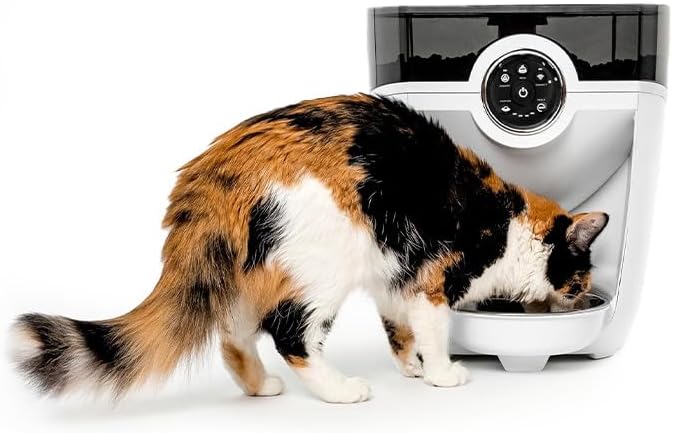
If budget is less of a concern and you crave the absolute pinnacle of smart, automated pet technology, the Whisker Feeder-Robot stands in a league entirely of its own. Manufactured by the same innovative company behind the famous, industry-leading Litter-Robot, my intensive hands-on testing revealed an incredibly sophisticated piece of hardware. It offers unmatched precision, reliability, and detailed analytics for the health-conscious, tech-obsessed pet parent.
Pros:
- Advanced, patented anti-jam technology guarantees meal delivery regardless of kibble shape
- Highly precise portion control (down to 1/8th of a cup) via the comprehensive Whisker app
- Sleek, modern, and highly attractive design with a secure auto-locking food hopper
- Dishwasher-safe components and high-quality BPA-free plastics ensure food safety
- Integrates flawlessly into the Whisker app ecosystem alongside the Litter-Robot
Cons:
- Premium positioning and advanced tech require a significantly larger upfront investment
- Considerable physical footprint may not suit small apartment kitchens or tight spaces
- App features might be overkill for someone just looking for basic, timed feeding
The Feeder-Robot feels significantly less like a standard pet accessory and much more like a high-end, luxury kitchen appliance. From the very moment I unboxed it, the premium build quality, weighty materials, and thoughtful engineering were blatantly apparent. The large hopper is made of heavily smoked plastic, allowing you to easily see the food level at a glance while crucially keeping the kibble protected from degrading UV light. But the real engineering magic happens inside; the Feeder-Robot uses a unique, powerful dispensing mechanism that ensures virtually zero jams. In my testing, it pushed through the most awkward, triangular, and large-breed kibbles without a single stutter.
Using the proprietary Whisker app completely changed how I monitored and managed my cat’s diet. It doesn’t just let you schedule basic meals; it provides detailed, historical analytics on your pet’s eating habits, tracking exactly when and exactly how much food was dispensed over time. You can set up incredibly complex feeding schedules to mimic natural hunting patterns, or simply tap the app for a quick, remote snack dispense from the office. The app will even alert you well in advance when the hopper is getting low, completely eliminating the sudden panic of realizing you’re out of cat food at dinner time.
What impressed me most deeply during my extended testing was the machine’s incredibly robust tamper resistance. The top locks securely with a satisfying mechanism, and the dispenser chute is cleverly designed with an internal baffle to prevent clever paws from reaching up and dislodging extra kibble. While it certainly comes at a steep premium price point, the absolute peace of mind, flawless mechanical execution, and deep integration into a smart home ecosystem make the Feeder-Robot a highly worthwhile investment for tech-savvy pet owners who demand the very best for their animals.
5. SureFeed Microchip Pet Feeder
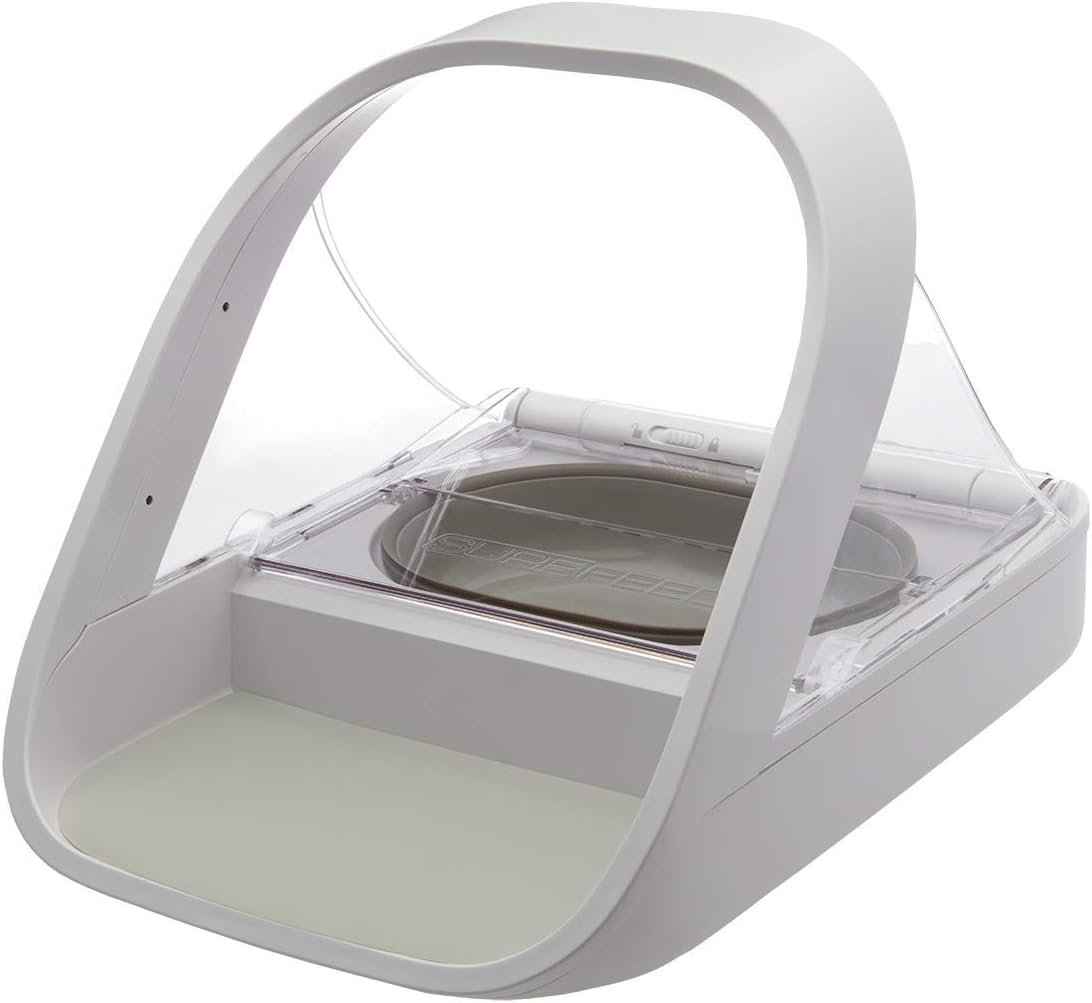
In multi-pet households, chronic food theft is a genuine, daily nightmare that can lead to obesity in one pet and malnourishment in another. I have one cat on a strict, expensive prescription diet and another resident feline who firmly believes all food belongs to him. The SureFeed Microchip Pet Feeder was the absolute only solution that definitively solved this deeply frustrating problem in my home. By optically reading your cat’s existing veterinary microchip, it acts as an exclusive, automated, and highly secure dining room.
Pros:
- Effectively and immediately stops food stealing in competitive multi-pet households
- Works seamlessly and reliably with your cat’s existing implanted veterinary microchip
- Sealed bowl mechanism keeps wet food fresher for significantly longer and prevents odors
- Ideal and necessary for administering expensive prescription diets or vital medications securely
- Training mode helps timid cats slowly get accustomed to the motorized lid movement
Cons:
- Does not operate on a timer; food is always available to the authorized pet once open
- Requires purchasing a separate, somewhat expensive unit for each pet requiring a secure diet
- Requires 4 C cell batteries, which adds to the long-term running costs
The sheer ingenuity of the SureFeed system became incredibly apparent the moment I programmed it. It takes mere seconds to register your cat’s microchip (or the included lightweight RFID collar tag if your pet isn’t chipped). The process is as simple as pressing a button and having the cat put their head near the hoop. When the authorized cat approaches the bowl, the motorized polycarbonate lid gracefully and quietly slides open, revealing the food. The absolute moment they step away or back out of the hoop, the lid rapidly but safely closes, sealing the bowl and firmly locking out any opportunistic housemates or roaming dogs. During my rigorous testing, my resident food-thief tried every conceivable angle to break in—prying with paws, headbutting the lid—but the SureFeed remained completely, frustratingly secure.
It’s vitally important to understand that this isn’t a timed feeder in the traditional sense; it absolutely does not dispense measured meals on a scheduled timer. Instead, it provides secure, exclusive, and constant access to pre-portioned food you place in the bowl. The sealed lid, however, has a phenomenal secondary benefit that I rapidly grew to love: it significantly extends the usable life of wet food by preventing it from drying out into unappetizing crust, and it keeps pungent pet food smells entirely contained within the unit. The included neoprene lip seal around the bowl rim does an excellent job of maintaining maximum freshness in warm environments.
While outfitting a multi-cat home with several of these advanced units can certainly add up financially, the massive savings in stolen prescription food, the prevention of veterinary bills related to obesity, and the complete reduction in my own daily stress levels made it entirely worthwhile. If you are struggling with a dominant, food-aggressive cat eating another’s food, or if you have a slow grazer who constantly has their expensive meals stolen by the family dog, the SureFeed Microchip Feeder is not just a luxury; it is an absolute necessity. It reliably brings order, fairness, and profound peace back to feeding time.
How to Choose the Best Automatic Cat Feeder: A Comprehensive Buyer’s Guide
After testing so many automatic feeders across various price points and feature sets, I’ve realized that the “best” model is highly subjective. It entirely depends on your specific lifestyle, your work schedule, your cat’s unique dietary needs, and how your household dynamically operates. Walking down the pet aisle or scrolling through endless, identical-looking online listings can be incredibly overwhelming. However, focusing on a few critical factors will swiftly guide you to the perfect purchase. Here is the detailed criteria I always consider before recommending a feeder to any pet parent.
1. Wet vs. Dry Food Capabilities
The very first and arguably most crucial decision is determining precisely what type of food your cat eats daily. The vast majority of automatic feeders on the market, especially the smart ones, are designed exclusively for dry kibble. These hopper-style dispensers hold large amounts of dry food and drop it into a bowl below via a motorized wheel or chute. If you attempt to put wet food, semi-moist food, or raw diets in these hoppers, you will catastrophically destroy the machine’s motor, void the warranty, and create a dangerous bacterial biohazard in your kitchen.
If your cat absolutely requires a wet food diet for kidney health, is on a raw diet, or you need a reliable way to dispense daily medication, you must look specifically for a carousel-style feeder (like the Cat Mate C500). These utilize a flat, rotating tray with individual serving compartments and usually include reusable ice packs hidden underneath to keep the perishable food safe for up to 24 hours. Keep in mind that wet food feeders fundamentally require daily cleaning and refilling, whereas a large dry food hopper can be conveniently left alone for weeks at a time.
2. Hopper Capacity and Refill Frequency
You must carefully consider how often you actually want to be refilling the machine and how many cats will be eating from it. Automatic feeders generally range from small, compact 2-liter capacities up to massive, towering 7-liter silos. If you have a single, small cat and want the feeder primarily for enforcing portion control and the convenience of sleeping in, a smaller 3-liter or 4-liter model is perfectly adequate, keeps the food fresher, and will take up significantly less floor space in a small apartment.
However, if you have a multi-cat household, feed large breed cats like Maine Coons, or travel frequently for long holiday weekends, opting for a 6-liter or larger model (like the WOPET) ensures you won’t ever run out of food while you’re away. Always calculate roughly how many cups of food your cats eat per week and compare that to the liter capacity of the hopper before making a final decision.
3. Power Supply, Backup Systems, and Total Reliability
An automatic feeder is entirely useless—and potentially dangerous to your pet’s health—if it stops working the moment the power goes out. In my extensive testing experience, having dual power supplies is an absolute, non-negotiable feature for any timed feeder. The best units plug directly into a standard wall outlet for their primary, reliable power but feature a built-in backup battery compartment (usually taking large D or C alkaline batteries).
If your home loses power during a summer storm, or if a clever, mischievous cat manages to unplug the AC adapter from the wall, the internal batteries will instantly kick in. This redundancy guarantees your pet doesn’t miss a vital meal. I strongly advise that you never buy a plug-in-only model if you intend to leave your cat alone for more than a few hours at a time. The peace of mind provided by battery backup is worth any slight increase in the purchase price.
4. Smart App Features vs. Offline LCD Programming
Do you want to control the feeder from your smartphone while at the office, or do you prefer simple, reliable buttons on the device itself? Wi-Fi-enabled smart feeders are fantastic for tech enthusiasts who crave peace of mind. They send push notifications to your phone when food is successfully dispensed, alert you when the hopper is running low, and allow you to adjust feeding times remotely from anywhere in the world. High-end models even include HD cameras and two-way audio so you can watch and interact with your cat while they eat.
However, smart feeders inherently rely on your home internet connection and the manufacturer’s external servers. If your home Wi-Fi is notoriously spotty, or if your router is prone to dropping 2.4GHz connections, a smart feeder might cause significantly more daily headaches than it solves. Offline models with traditional LCD screens and physical buttons are incredibly robust, reliable, and entirely immune to internet outages, server crashes, or app updates. Though they can be slightly more tedious to program initially, they simply work. Choose based on your personal comfort with technology and the proven reliability of your home network infrastructure.
5. Anti-Jam Technology and Feline Tamper Resistance
Cats are incredibly intelligent, resourceful, and relentless when they are hungry and know where the food is stored. I’ve watched my own cats try to systematically knock tall feeders over, forcefully pry the hopper lids off with their teeth, and contort themselves to reach their paws far up the dispensing chute to dislodge extra kibble. It is imperative to look for feeders heavily engineered with wide, low-center-of-gravity bases that resist tipping.
Furthermore, secure, locking lids (such as twist-locks or dual-button-release mechanisms) are far superior to simple snap-on lids. Additionally, you must read user reviews specifically mentioning the machine’s anti-jam technology. A high-quality feeder should possess a robust, high-torque internal motor and a flexible dispensing wheel design (often using silicone impellers) that can seamlessly handle different shapes, sizes, and textures of kibble without ever getting stuck and trapping the food inside.
6. Ease of Cleaning and Hygiene
Feline acne and gastrointestinal issues can often be traced back to dirty food bowls harboring dangerous bacteria. Therefore, the ease with which a feeder can be cleaned should heavily influence your purchase. Look for models featuring removable, high-quality stainless steel or ceramic food bowls, as these materials are non-porous and far easier to sanitize than cheap plastics. Furthermore, ensure that the internal food hopper and the dispensing chute can be easily detached from the motorized base unit for regular washing in the sink. If a feeder requires unscrewing multiple tiny parts just to clean the food path, you are far less likely to maintain it properly.
Frequently Asked Questions About Automatic Cat Feeders
Can automatic cat feeders attract bugs or pests?
This is a very common concern, and in my experience, the answer depends entirely on the design of the feeder and your home environment. Most high-quality automatic feeders for dry food feature secure, locking lids with silicone seals that do an excellent job of keeping ants and other pests out of the main food hopper. However, the dispensing chute and the food bowl itself are open to the air. If you leave dispensed food sitting in the bowl for long periods, it can potentially attract pests. The best way to prevent this is to program smaller, more frequent meals so your cat eats the food immediately upon dispensing, leaving an empty bowl behind. For wet food feeders like the SureFeed Microchip Feeder, the sealed lid design is exceptional at preventing flies and ants from accessing the food, making it the safest option in pest-prone areas.
How long can I leave my cat alone with an automatic feeder?
While automatic feeders are fantastic for convenience and short trips, they are not a substitute for human care. With a reliable, large-capacity feeder (like a 6L model) and a secondary water fountain, your cat has access to sustenance for weeks. However, I strongly advise against leaving a cat completely unattended for more than 48 hours. Feeders can occasionally jam (even the best ones), batteries can die unexpectedly, and cats can experience sudden medical emergencies. An automatic feeder allows you to take a weekend trip with peace of mind, but for anything longer than two days, you should always have a pet sitter, friend, or neighbor physically check on your cat, ensure the machine is working, and clean the litter box.
Are automatic cat feeders difficult to clean?
The difficulty of cleaning varies wildly between models. In my testing, this was one of the biggest differentiating factors between cheap knock-offs and premium brands. Wet food carousel feeders must be cleaned every single day to prevent bacterial growth, but thankfully, most feature dishwasher-safe trays and lids. Dry food hopper feeders should be completely emptied and deep-cleaned at least once a month. The oils from dry kibble build up over time and can go rancid, leading to feline acne and food refusal. Look for models where the hopper, the internal dispensing wheel, and the bowl detach completely from the motorized base unit so you can wash them safely in warm, soapy water without risking damage to the electronics.
Do automatic feeders help with cat weight loss?
Absolutely. In fact, this is arguably the most important health benefit of an automatic feeder. Feline obesity is an epidemic, largely caused by “free-feeding”—leaving a giant bowl of food out all day. Cats are naturally grazers who eat multiple small meals. An automatic feeder allows you to program 4 to 6 very small, strictly measured portions throughout a 24-hour period. This closely mimics their natural eating patterns, keeps their metabolism active, and completely eliminates the possibility of overeating. If you use the precise portion controls accurately, an automatic feeder is an invaluable tool for helping a chunky cat slowly and safely return to a healthy weight.
What should I do if my cat is afraid of the automatic feeder?
It is entirely normal for a cat to be startled by an automatic feeder at first. The sudden sound of the motor whirring and hard kibble loudly hitting a stainless steel bowl can be frightening to timid cats. The key is slow, positive reinforcement. Do not immediately remove their old food bowl. Instead, place the new automatic feeder next to their old bowl. Manually place a few treats in the new feeder’s bowl so they associate it with high-value rewards. Once they are comfortable eating treats from it, run a manual dispense while they are in the room so they can observe the noise. Some advanced models, like the SureFeed Microchip Feeder, even feature a built-in “training mode” that slowly introduces the movement of the lid over several days. Patience is critical; most cats adapt within a week once they realize the noisy machine is the source of their dinner.
Can I use semi-moist food in a dry food feeder?
No, you should never put semi-moist food, raw food, or freeze-dried food that has been rehydrated into a standard hopper-style dry food feeder. These machines rely on hard, dry kibble flowing smoothly through the internal mechanisms. Semi-moist food is sticky and will rapidly accumulate on the dispensing wheel, causing a severe jam that can burn out the motor. Furthermore, the hopper is not refrigerated, so semi-moist food will quickly spoil and become a breeding ground for dangerous bacteria. Stick strictly to hard kibble for hopper models, and use carousel-style models with ice packs for anything that contains moisture.
Final Thoughts and Conclusion
Investing in a high-quality automatic cat feeder is unequivocally one of the best, most transformative decisions a dedicated cat owner can make. It entirely removes the daily friction and frustration from early morning wake-ups, enforces strict, healthy portion control to combat the rampant issue of feline obesity, and provides truly invaluable peace of mind when your busy life keeps you away from home. The transition from being a manual food provider to an automated system improves the bond with your pet, as they no longer associate you solely with the anxiety of waiting for their next meal.
Whether you ultimately opt for a highly advanced, tech-forward smart feeder with an integrated camera to watch your pet from the office, or a robust, simple, and utterly dependable offline model that just does its job quietly in the corner, ensuring consistent, reliable meals for your feline friend will make both of your lives significantly better. By carefully evaluating your cat’s specific dietary requirements, your home’s technological capabilities, and your household’s daily routine against the detailed criteria in this guide, you can confidently easily find the perfect automated dining solution that will serve you and your cat for years to come.
 ✓
✓