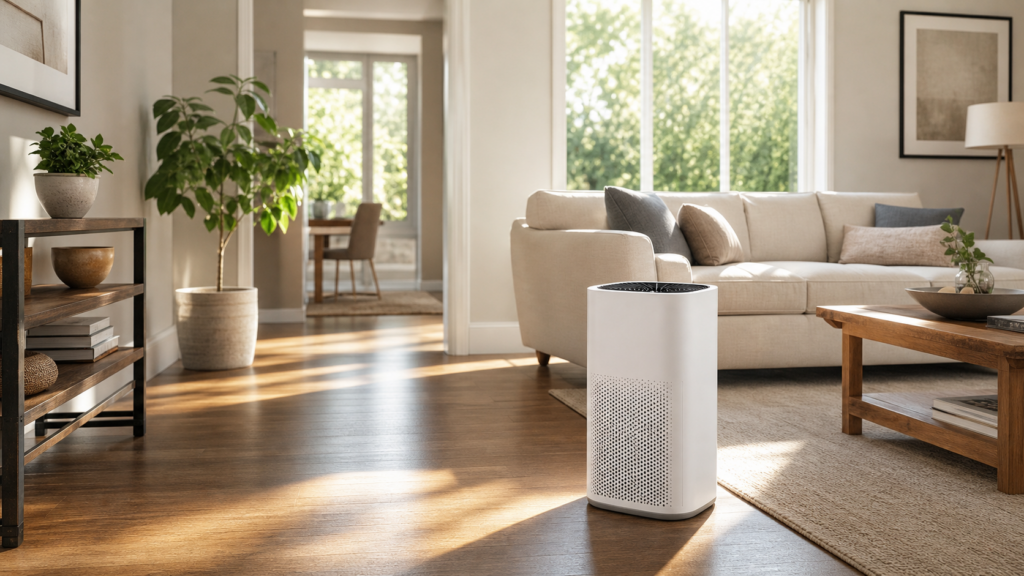
Buying a good air purifier is only part of the solution to improving your home’s indoor air quality. Where you place the unit can have a major effect on how efficiently it captures dust, pollen, pet dander, smoke particles, and other airborne contaminants.
An air purifier hidden behind a couch or squeezed into a corner may still run, but it will not clean the room as effectively as a properly positioned unit. The purifier needs enough open space to pull polluted air into its intake and distribute filtered air throughout the room.
So, where should you place an air purifier? In most rooms, the best location is an open area with good airflow, several inches away from walls, furniture, curtains, and other objects. It should be placed in the room where you spend the most time or where the main source of air pollution is located.
Why Air Purifier Placement Matters
Air purifiers work by pulling surrounding air through one or more filters. Depending on the model, those filters may capture larger dust particles, fine particulate matter, allergens, smoke, and certain odors. For this process to work efficiently, air must be able to reach the purifier’s intake without obstruction. Clean air must also be able to leave the machine and circulate around the room.
When an air purifier is placed too close to a wall or blocked by furniture, it may repeatedly filter the same small pocket of air. Pollutants on the other side of the room may remain airborne much longer.
- Clean the room more evenly
- Capture pollutants closer to their source
- Improve air circulation
- Operate more efficiently
- Produce better results at lower fan speeds
- Reduce the time needed to clean the room’s air
Placement cannot make an undersized purifier powerful enough for a large room, but it can help you get the best possible performance from the unit you already own.
The Best General Location for an Air Purifier
For most homes, an air purifier should be placed in an open part of the room where airflow is not restricted. Leave at least 6 to 12 inches of clearance around the purifier unless the manufacturer recommends a different distance. Some models with air intakes on multiple sides may benefit from even more open space.
Before choosing a location, identify the purifier’s intake and outlet. The intake is often found on the sides, back, or lower section of the unit. Filtered air commonly exits through the top or front. Neither area should be blocked.
A central location can provide excellent circulation, but placing a machine directly in the middle of a room is not always practical. A position near a wall can work well as long as you maintain the manufacturer’s recommended clearance and keep the air intake unobstructed.
Should an Air Purifier Be on the Floor or a Table?
The answer depends on the purifier’s size and intake design. Most large, floor-standing air purifiers are designed to sit directly on a hard, level floor. Placing a large unit on a table may make it unstable and could increase noise or vibration.
Smaller tabletop purifiers can be placed on a sturdy dresser, desk, nightstand, or shelf. Raising a compact purifier can be helpful when the main concern is smoke or other fine particles that remain suspended in the air.
- Make sure the surface is stable and level.
- Keep fabric and other objects away from the intake.
- Give the air outlet adequate clearance.
- Position the power cord so it does not create a tripping hazard.
Avoid placing a purifier on a soft surface such as a bed, couch, or thick carpet unless the manufacturer specifically permits it. Soft materials can restrict lower air intakes and may cause the unit to operate less efficiently.
Best Air Purifier Placement in a Bedroom
The bedroom is one of the most valuable places to use an air purifier because most Americans spend several hours there every night. Position the purifier relatively close to the bed, but do not aim a strong stream of air directly at your face. Continuous airflow may feel uncomfortable or contribute to dryness while you sleep.
A distance of approximately 6 to 10 feet from the head of the bed works well in many bedrooms. The exact distance will depend on the room’s size, the purifier’s airflow, and your sensitivity to fan noise.
Keep the unit away from curtains, loose bedding, clothing piles, and corners with limited airflow. If you are using the purifier for nighttime allergies, keep the bedroom door and windows closed while it is operating. This allows the machine to concentrate on filtering the air within a defined space.
Run the purifier for at least 30 to 60 minutes before bedtime when possible. For more consistent air quality, leave it running continuously at a comfortable speed.
Best Placement in a Living Room
The living room is often one of the largest and busiest areas in a home. It may also contain several sources of airborne particles, including upholstered furniture, rugs, fireplaces, open doors, pets, and frequent foot traffic.
Place the purifier in an open area near the main seating zone. Make sure sofas, chairs, tables, and media consoles do not block its air intake. If your living room connects to a kitchen or hallway, avoid assuming that one small purifier will effectively clean the entire open floor plan. A large open area may require a more powerful model or multiple units.
Homes with a fireplace should position the purifier where it can capture particles that enter the room without exposing the machine to excessive heat. Never place an air purifier directly beside a fire, stove, or other high-temperature source.
Best Placement in a Kitchen
An air purifier can help reduce airborne particles and lingering cooking odors, but it is not a substitute for a properly vented range hood. Place the purifier several feet away from the cooking area. Positioning it too close to the stove can expose the filters to grease, moisture, and heat.
A location near the entrance to the kitchen or between the kitchen and an adjoining living area may help capture particles and odors as they spread. Keep the machine away from the sink, direct heat, splash zones, and locations where its cord would cross a walkway.
Use the range hood while cooking, especially when frying, searing, or using a gas stove. The purifier can then provide additional filtration after the main ventilation system removes heat and cooking emissions.
Best Placement for Pet Hair and Dander
If you share your home with a dog or cat, place the purifier in the room where your pet spends the most time. A location near a pet bed or favorite couch can be effective, but leave enough distance to prevent loose hair from rapidly accumulating on the intake. Check the pre-filter frequently, especially during shedding seasons.
Remember that an air purifier is primarily designed to capture airborne particles. It will not remove pet hair that has already settled on floors, rugs, or furniture. Regular vacuuming, grooming, damp dusting, and washing pet bedding remain important.
Best Placement for Wildfire Smoke
Wildfire smoke can affect indoor air quality even when a fire is hundreds of miles away. During a smoke event, place the purifier in the room where household members spend the most time.
Keep exterior doors and windows closed and set the purifier to a higher fan speed when indoor particle levels rise. If you have only one unit, it may be more effective to create a cleaner-air room than to move the purifier constantly throughout the house.
A bedroom or living room can serve as the designated cleaner-air space. Keep the room closed as much as practical and limit activities that create additional indoor particles, such as burning candles, smoking, or frying food. Placement helps, but the machine’s Clean Air Delivery Rate and room-size capacity are equally important.
Where You Should Not Put an Air Purifier
Behind Furniture
A purifier hidden behind a couch, bookcase, or television stand cannot pull air freely from the room. Even a small obstruction can restrict airflow if it covers the intake.
In a Corner
Corners usually have weaker air circulation. A purifier placed tightly between two walls may clean the surrounding pocket of air instead of the entire room.
Near Open Windows or Exterior Doors
An open window can introduce pollen, smoke, exhaust, and humidity faster than the purifier can remove them. Strong drafts may also push filtered air out of the room.
In a Humid Bathroom
Most standard air purifiers are not designed for wet environments. Excessive humidity can affect filters, electronics, and sensors. Use a bathroom exhaust fan to control moisture.
Should You Move Your Air Purifier Between Rooms?
You can move a portable air purifier between rooms, but doing so is usually less effective than running it consistently in one high-priority space. Air pollution does not disappear permanently after the purifier runs for a short time. New particles enter whenever people walk through the room, doors open, pets move around, or outdoor air leaks inside.
If you own one purifier, use it in the living area during the day and move it to the bedroom before you go to sleep. Allow it to run in the bedroom long enough to reduce airborne particles before bedtime. For continuous coverage, separate purifiers in frequently occupied rooms offer greater convenience and more consistent results.
How to Improve Air Purifier Performance
Correct placement works best when combined with basic maintenance and sensible household habits. Replace or clean filters according to the manufacturer’s instructions. A clogged filter reduces airflow and can make even a well-positioned purifier less effective.
Use a fan speed that moves enough air for the room. Automatic mode is convenient, but built-in sensors do not detect every type of pollutant. During cooking, cleaning, wildfire smoke, or high-pollen conditions, manually increasing the fan speed may provide better results.
Keep doors and windows closed when outdoor air quality is poor. Vacuum and dust regularly so settled particles do not become airborne again. Use exhaust fans where appropriate and control excess indoor humidity.
Frequently Asked Questions
Can I put an air purifier next to my bed?
Yes, but avoid placing a powerful unit so close that air blows directly onto your face. A position several feet away from the bed usually provides effective filtration with less noise and draft.
Can an air purifier sit against a wall?
Only if the manufacturer allows it and the wall does not block the intake. Most models perform better with at least several inches of clearance.
Is it better to place an air purifier high or low?
Large floor models should generally remain on the floor. Compact models may work well on a stable table or dresser. The best height depends on the purifier’s design and the pollutants you want to capture.
Should I leave my air purifier running all day?
Air purifiers are generally most effective when operated continuously because airborne particles constantly reenter a room. You can reduce the fan speed when the room is unoccupied or when noise is a concern.
Can one air purifier clean an entire house?
Usually not. Walls, closed doors, hallways, and multiple floors restrict airflow. One purifier may help in a small open space, but most homes need separate units for consistent filtration in multiple rooms.
Final Thoughts
The best place for an air purifier is an open, unobstructed area in the room where you spend the most time or where airborne pollution is most noticeable. Keep the unit away from corners, curtains, furniture, heat, and moisture. Provide adequate clearance around its air intake and outlet, and place it close enough to the pollution source to capture particles without exposing it to grease, water, or excessive debris.
A few feet of difference in placement can affect how efficiently air circulates through the machine. Combine thoughtful positioning with the correct purifier size, regular filter maintenance, and good ventilation habits to achieve cleaner, more comfortable air throughout your home.
Leave a Reply