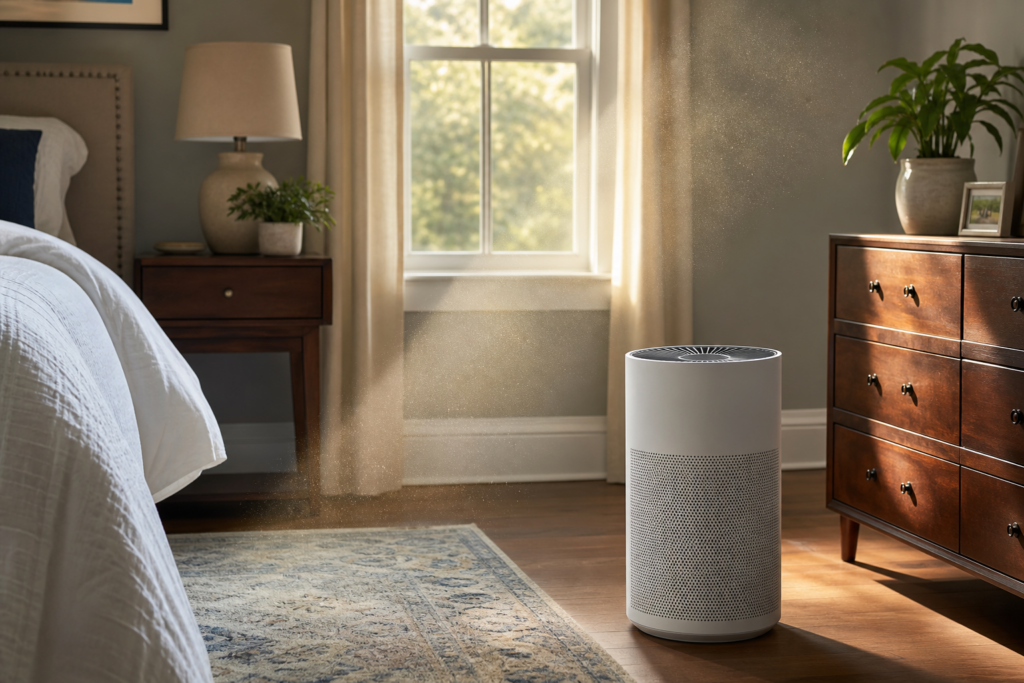
An air purifier can run quietly for hours without producing an obvious visual change, so it is reasonable to wonder whether the machine is actually doing anything. Unlike a vacuum, an air purifier does not leave a visible path behind it. Most of its work happens inside the filter as room air moves through the unit.
The clearest signs that an air purifier is working are steady airflow from the outlet, dust or debris accumulating on the pre-filter, fewer airborne particles over time, and a noticeable improvement in certain odors or irritation triggers. A particle monitor can provide more objective evidence, but you can perform several useful checks without buying another device.
No single test proves that every pollutant has been removed. Results depend on the filter type, room size, fan speed, placement, maintenance, and the source of the pollution. The goal is to confirm that air is moving through a clean, correctly installed filter and that conditions improve under repeatable circumstances.
Start With the Airflow Test
Place your hand a few inches above or in front of the clean-air outlet while the purifier is running. You should feel a consistent stream of air that becomes stronger as you increase the fan speed. The exact direction varies by design: many tower units exhaust upward, while some compact models send air forward.
Weak airflow does not automatically mean the motor has failed. A clogged filter, blocked intake, protective packaging left on a replacement filter, or furniture positioned too close to the machine can all restrict circulation. Turn the unit off before opening it, then confirm that the filter is installed in the correct direction and that all plastic wrapping has been removed.
- Confirm that airflow changes when you select a higher fan speed.
- Check every intake panel for curtains, walls, dust, or other obstructions.
- Listen for unusual rattling, surging, or repeated stopping.
- Follow the manufacturer’s clearance and filter-installation instructions.
Inspect the Pre-Filter and Main Filter
After a few weeks of regular use, the pre-filter commonly develops a light coating of lint, hair, and household dust. That buildup is direct evidence that room air is reaching the machine and larger particles are being captured. Homes with pets, carpeting, open windows, or frequent foot traffic may see buildup sooner.
The main filter may change color gradually, but appearance alone is not a reliable replacement guide. Fine particles can load a filter even when the surface does not look dramatically dirty. Inspect it only as directed, avoid touching delicate pleats, and use the replacement interval or filter indicator as a starting point rather than waiting for the filter to become completely blocked.
Notice Changes in Dust, Allergens, and Odors
A properly sized purifier may reduce the amount of fine dust that remains suspended in the room, but it will not eliminate all dust from furniture. Larger particles often settle before they reach the intake. Regular vacuuming and damp dusting are still necessary, especially around fabrics and pet areas.
Odor changes can be another clue when the purifier includes an activated-carbon stage. Cooking smells, pet odors, and light smoke may fade faster, although carbon capacity varies widely. A standard particle filter is not designed to remove every gas or odor, so a lack of odor improvement does not necessarily mean the particle filter is ineffective.
Use a Particle Monitor for a More Objective Check
A separate indoor air-quality monitor that measures fine particulate matter can show whether particle levels decline while the purifier runs. For a simple comparison, close windows and doors, record the starting reading, operate the purifier at a consistent speed, and check the trend over the next hour or two.
Keep the monitor several feet away from the purifier rather than directly beside the clean-air outlet. A sensor placed in the purified air stream can report an unrealistically low reading that does not represent the rest of the room. Repeat the test under similar conditions and focus on the overall trend instead of reacting to every short spike.
Check Whether the Purifier Is Correctly Sized
A small purifier may be functioning normally yet struggle to produce a noticeable change in a large living room. Compare the model’s recommended room size and Clean Air Delivery Rate with the actual space. Open doorways, high ceilings, and connected rooms increase the volume of air the machine must handle.
For faster results, run the purifier at a higher setting when the room is occupied or when particle levels rise. A low sleep setting may be quiet, but it moves less air. If the machine only seems effective on its highest setting, the room may be near the limit of its practical capacity.
Make Sure Placement Is Not Limiting Performance
An air purifier needs open space around its intake and outlet. Pushing it tightly into a corner or hiding it behind a sofa can cause the unit to recirculate the same pocket of air. Leave the clearance recommended in the manual and keep loose curtains, bedding, and clothing away from the intake.
Place the purifier in the room where you spend the most time or near the main source of particles without exposing it to heat, grease, or moisture. Consistent operation in one high-priority room is generally easier to evaluate than moving the machine from place to place throughout the day.
Understand What the Built-In Sensor Can and Cannot Tell You
Many purifiers use a colored light or numerical display to represent air quality. These indicators can be helpful, but the sensor may respond only to certain particles. It may not detect pollen, gases, odors, or every pollutant that matters in your home.
A sensor that always shows clean air may simply be positioned in the machine’s own filtered airflow or may need gentle cleaning according to the manual. Compare its response during a known event, such as vacuuming in another part of the room, but never create smoke or other pollution just to test the sensor.
Signs That the Purifier Needs Attention
Performance often declines gradually as a filter loads with particles. A sudden reduction in airflow, a persistent new odor from the unit, warning lights that return after a reset, or abnormal mechanical noise deserves attention. Turn the machine off and inspect the accessible components before continuing to use it.
Do not wash a filter unless the manufacturer specifically identifies it as washable. Water can damage many pleated filters and may create conditions for odor or microbial growth. If a new filter and correct setup do not restore normal airflow, contact the manufacturer or a qualified repair service.
Frequently Asked Questions
How quickly should an air purifier improve a room?
A correctly sized purifier can begin reducing airborne particles as soon as it runs, but the time needed for a measurable change depends on room volume, fan speed, open doors, and continuing pollution sources. Evaluate the trend over at least an hour rather than expecting an instant transformation.
Should I see dust moving toward the purifier?
Usually not. Air movement is often too gentle to see, and larger dust particles may settle before reaching the intake. Airflow at the outlet and debris on the pre-filter are more useful signs.
Why does my air-quality light stay red?
The room may contain an ongoing particle source, the purifier may be undersized, or the sensor may need cleaning. Cooking, candles, outdoor smoke, humidifier mist, and aerosol products can also affect some sensors.
Does a clean filter mean the purifier is not working?
Not necessarily. Fine-particle buildup can be difficult to see, and a low-dust room may load the filter slowly. Confirm airflow, installation, operating time, and room conditions before drawing a conclusion.
Can an air purifier remove all dust?
No. It can capture some dust while it is airborne, but it cannot remove particles that have already settled on floors and furniture. Filtration works best alongside vacuuming, damp dusting, and source control.
Final Thoughts
The simplest way to confirm that an air purifier is working is to verify strong, consistent airflow and inspect the pre-filter for captured debris after regular use. Changes in airborne particles, odors, and comfort can support that conclusion, while a separate particle monitor provides a clearer before-and-after comparison.
If results are disappointing, check placement, fan speed, filter installation, maintenance, and room size before assuming the purifier is defective. A functioning machine still needs the right conditions to clean the room effectively.
Leave a Reply