Best Outdoor Security Cameras for Driveways, Yards, and Night Monitoring
Compare five outdoor security camera options for driveways, yards, and nighttime monitoring, from battery and solar models to wired 4K systems.
As an Amazon Associate I earn from qualifying purchases.
A driveway camera has a different job from a camera watching a backyard gate. One may need to identify vehicles at the curb, while another must cover a wide lawn, tolerate weather, or keep recording overnight without frequent maintenance. The best choice depends on power access, lighting, storage, and how much area you need to monitor.
This guide compares five options using the supplied product information. It includes battery-powered, solar-powered, Wi-Fi, pan-and-tilt, and wired Power over Ethernet (PoE) systems. Product details and features can change, so verify the current listing, app requirements, storage terms, and installation needs before buying.
Quick comparison
| Camera or system | Best fit | Power and connection | Notable tradeoff |
|---|---|---|---|
| HITELLARCAM CB54W | Flexible single-camera coverage | Rechargeable battery; Wi-Fi | Battery life depends heavily on activity and conditions |
| aosu D1 Classic 4-Cam Kit | Multiple outdoor views | Solar powered; wireless | Solar placement and sunlight matter |
| Tapo C500 | Wide-area view near an outlet | Corded electric; Wi-Fi | Requires nearby power and separate storage for local recording |
| Reolink RLK8-800D4 | Dedicated wired home coverage | PoE; NVR-based | Installation is more involved than a wireless camera |
| Reolink RLK16-800B8 | Large property or many camera positions | PoE; NVR-based | Not a Wi-Fi system and supplied evidence is limited |
Our picks for outdoor driveway and yard security
1. HITELLARCAM 2K Wireless Outdoor Camera: Best flexible single-camera pick

The HITELLARCAM CB54W is a practical starting point for renters or homeowners who want one wireless camera without running a network cable. The supplied information lists 2K video, full-color night vision with built-in LED lights, motion alerts, two-way audio, IP66 water and dust resistance, and compatibility with both 2.4GHz and 5GHz Wi-Fi. It also works with Amazon Alexa.
For a driveway, the rechargeable design can simplify placement where an outlet is inconvenient. In a yard, the spotlight and color night vision may provide more useful context than a basic infrared-only view, particularly near a walkway or side gate. The app can send motion notifications and supports two-way conversations with visitors or delivery drivers.
The main tradeoff is battery uncertainty. The listing says battery life may range from one to six months, while also explaining that a test scenario with 100 motion triggers per day produced about 60 days and that lower activity could theoretically extend runtime. Cold weather, frequent activity, recording behavior, and Wi-Fi conditions can all affect results. Free cloud storage is included, but the supplied notes say its free plan uses SD quality; HD cloud storage requires a paid plan. Local storage supports a separately purchased microSD card up to 256GB.
Who should choose it: Someone who wants a flexible, single-camera installation with color night monitoring and does not mind periodically charging a battery.
Verify before buying: Confirm the app’s current storage rules, whether your Wi-Fi signal reaches the mounting location, and how often you are likely to recharge it in your climate.
2. aosu D1 Classic 4-Cam Kit: Best for covering several outdoor areas

The aosu D1 Classic is a four-camera wireless kit designed for homeowners who need more than one viewpoint. Its supplied features include 2K resolution, solar power, 360-degree coverage with pan-and-tilt functionality, automatic motion tracking, color night vision, two-way audio, and a 32GB aosuBase for local encrypted storage without a subscription. The system can also show four live streams at once and supports Alexa, Google Assistant, and SmartThings.
This configuration makes sense for a property with several exposure points, such as a driveway, front walk, backyard, and side passage. Solar charging can reduce routine battery maintenance, and the listing says three hours of sunlight per day keeps the system running, including on rainy and cloudy days. That claim is dependent on placement and local conditions, so it should be treated as a planning guideline rather than a guarantee.
Pan-and-tilt movement and automatic tracking can help follow activity across a broader area than a fixed camera. However, a moving lens is not the same as simultaneous coverage of every direction. A camera may be looking elsewhere when an event begins, so consider whether each important entry point still needs its own dedicated view. The IP65 rating is listed for outdoor use, and the system requires suitable locations for solar exposure.
Who should choose it: Homeowners who want several wireless outdoor viewpoints and prefer local storage without a required subscription.
Verify before buying: Check whether each mounting position receives enough useful sunlight, confirm the base station’s placement and range, and decide whether pan-and-tilt coverage is adequate for your specific blind spots.
3. Tapo C500: Best for wide coverage near an outlet

The Tapo C500 is a corded outdoor Wi-Fi camera for locations where continuous power is available. It offers 1080p video, a 360-degree horizontal and 130-degree vertical viewing range, person detection, motion tracking, two-way audio, and a customizable sound alarm. The supplied evidence lists night vision up to 98 feet and an IP65 rating. It works with Amazon Alexa and Google Assistant, with limitations noted for Google display streaming.
Its pan-and-tilt design is useful for a driveway or open yard where a fixed lens would leave large areas outside the frame. Person detection can make alerts more relevant than generic motion notifications, while the physical privacy mode blocks the lens with the housing when the camera should not be viewing.
This model’s defining compromise is power. It is not a battery or solar camera, so you need a suitable outdoor outlet and a cable route that remains protected from weather and tampering. Video can be saved to a separately purchased microSD card up to 512GB or through Tapo Care cloud storage. Cloud features and subscription terms should be checked in the current listing before purchase.
Who should choose it: Buyers who want broad pan-and-tilt coverage, tracking, and smart alerts at a location with dependable power.
Verify before buying: Measure the distance to the outlet, inspect the planned cable path, and check the current cloud-storage options if you do not want to purchase a microSD card.
4. Reolink RLK8-800D4: Best for a dedicated wired system
The supplied evidence identifies the Reolink RLK8-800D4 as an eight-channel, 4K/8MP home security system with four H.265 PoE turret cameras and a 2TB hard drive in its NVR. Beyond those title-level details, no additional product evidence was supplied for this article, so prospective buyers should review the current listing carefully before relying on specific detection, night-vision, weather-resistance, or recording claims.
A PoE system can be a strong fit for a homeowner who wants a more permanent installation than a battery camera. Ethernet cabling carries data and power to compatible cameras, while the NVR provides a central place to manage recordings. The eight-channel capacity also leaves room to think about future camera locations, although expansion compatibility and included accessories should be confirmed.
The tradeoff is installation effort. You will need suitable cable routes, an appropriate network and power arrangement, and a place for the recorder. It is less convenient for a renter or for a temporary camera position. Wired systems can also be harder to reposition after installation, even though they may be better suited to continuous recording than battery models.
Who should choose it: Homeowners planning a permanent, multi-camera setup and willing to run cable for centralized recording.
Verify before buying: Confirm the exact cameras and NVR included, cable requirements, supported recording modes, remote-access terms, and whether the system fits your home’s installation layout.
5. Reolink RLK16-800B8: Best for a large property and many camera positions

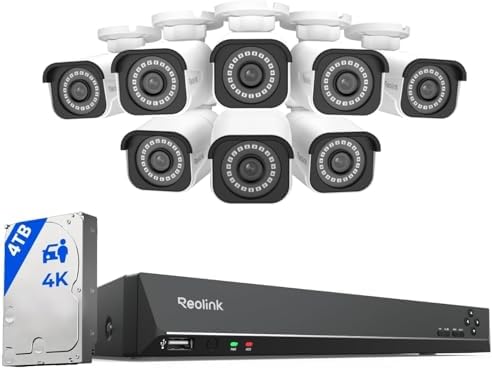
The Reolink RLK16-800B8 is listed as a 16-channel 4K security bullet camera system with eight cameras and a 4TB hard drive. The supplied evidence also states that it uses PoE, supports person, vehicle, and animal detection, offers remote access through the Reolink app, and supports continuous, scheduled, and motion recording. The listing notes a 100-foot night-vision range and says the NVR can support storage capacity up to 16TB.
This is the most expansive option in the list for a property that needs many viewpoints. Eight included cameras can be positioned around a larger home, detached garage, driveway approaches, and yard boundaries, while the 16-channel recorder leaves theoretical room for additional compatible cameras. The included 4TB drive is intended for local recording rather than relying on a cloud subscription.
There are important compatibility limits. The supplied notes say the cameras work only with the Reolink PoE NVR, are not Wi-Fi cameras, and cannot work with smart-home devices such as Alexa. That makes this a specialized surveillance system rather than a casual plug-in camera. You should also plan for visible or protected Ethernet runs and a suitable location for the NVR.
Who should choose it: Owners of larger properties who want multiple wired views, local 24/7 recording, and room to build out a PoE system.
Verify before buying: Confirm cable lengths, camera placement, NVR expansion limits, network access, and whether the lack of Wi-Fi or Alexa support conflicts with your home setup.
How to choose an outdoor camera for night monitoring
Start with the power plan
Battery cameras are easier to place but need charging. Solar cameras reduce that chore but need an appropriate sky view. Corded models provide steady power but require an outlet and protected cable routing. PoE systems need Ethernet runs but can support a permanent installation and centralized recording.
Match the view to the property
A fixed camera can be predictable and easy to aim at a door or driveway entrance. Pan-and-tilt cameras cover more territory, but movement can leave another area outside the frame. For valuable entry points, prioritize a view that consistently captures faces, vehicles, or package activity rather than simply choosing the widest advertised coverage.
Understand night vision and storage
Color night vision often depends on built-in lighting or available ambient light; infrared night vision may show a monochrome image. Look for a stated range that matches the distance from the mounting point to the area of interest, and check whether the camera records continuously or only after motion. Storage can be local, cloud-based, or both. Free storage may have quality or retention limits.
Plan for alerts and privacy
Motion alerts are useful only when they are manageable. Person, vehicle, or animal detection may reduce unnecessary notifications, but no automated classification is perfect. Aim cameras away from neighbors’ windows and public spaces where possible, use privacy features when available, and review local rules or lease requirements before installation.
FAQ
Are wireless cameras better for a driveway?
Not automatically. Wireless cameras are convenient where cable installation is difficult, but a wired or PoE camera may be preferable for dependable power and continuous recording. The right choice depends on outlet access, Wi-Fi strength, and maintenance tolerance.
Is a solar camera reliable at night?
A solar camera normally stores energy for nighttime operation, but performance depends on sunlight, weather, placement, and activity levels. Check the product’s charging guidance and choose a location that receives useful daylight.
Do outdoor cameras need a subscription?
Some support local storage, while others offer optional cloud plans. In this list, the aosu system specifically describes local encrypted storage without a subscription, while the HITELLARCAM and Tapo evidence describes both local and cloud options with conditions to verify.
Bottom line
The HITELLARCAM is the most flexible single-camera option, the aosu kit is aimed at multi-area wireless coverage, and the Tapo C500 suits a powered location that benefits from pan-and-tilt viewing. The Reolink systems are better considered for permanent PoE installations, with the RLK16-800B8 aimed at larger deployments. Before ordering, map each camera’s view, power source, Wi-Fi or cable route, nighttime distance, and storage plan.
 ✓
✓