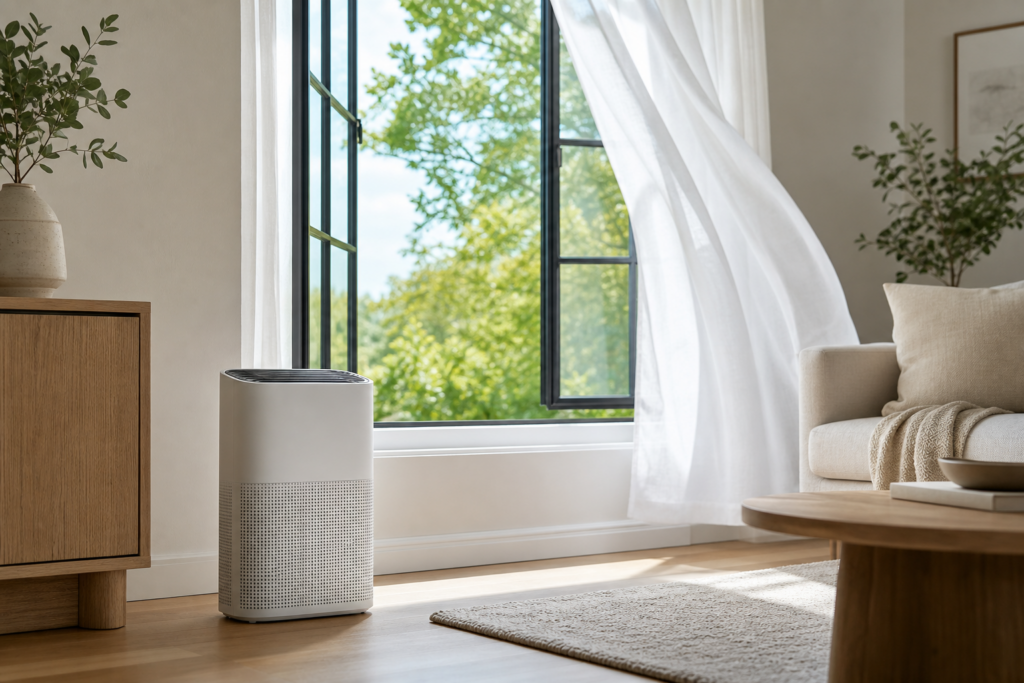
An air purifier can operate with the windows open, but it usually cannot clean the room as efficiently. Outdoor air continuously enters with pollen, smoke, dust, humidity, and traffic pollution, while filtered indoor air escapes. The machine must keep treating a changing supply of air instead of recirculating the same enclosed room.
Keep windows closed when outdoor air quality is poor, pollen is high, or you are trying to create a cleaner-air room. Open them when outdoor conditions are good and ventilation is needed to remove indoor heat, moisture, carbon dioxide, cooking emissions, or odors that a particle filter may not handle well.
The best choice is not always filtration or ventilation. Many homes benefit from short periods of deliberate ventilation followed by closed-window filtration. Weather, outdoor pollution, indoor activities, and the type of purifier all affect the decision.
Why Open Windows Reduce Purifier Efficiency
Portable air purifiers are generally rated for a defined room volume. With doors and windows closed, the machine can pass much of that room air through the filter repeatedly. An open window turns the room into a moving system with an uncontrolled amount of replacement air.
A light breeze may introduce particles faster than a small purifier can remove them. The unit is still capturing some material that reaches its intake, but the overall particle level may remain elevated. Strong cross-ventilation can also carry filtered air out of the room before it mixes throughout the space.
Keep Windows Closed During Wildfire Smoke
During a smoke event, close windows and exterior doors as much as practical and operate a suitable purifier in the room where people spend the most time. Limit indoor particle sources such as candles, smoking, and frying. Check local air-quality guidance and follow public-health instructions for severe events.
No typical home is perfectly sealed, so some outdoor smoke may still enter through gaps and ventilation systems. A well-sized purifier can reduce indoor particle levels, but it cannot make an unsafe building completely protective under every condition. Replace heavily loaded filters when needed.
What to Do During High-Pollen Days
Open windows can bring pollen directly into bedrooms and living spaces. When pollen counts are high or symptoms are worse, keep windows closed and use air conditioning or filtered mechanical ventilation when available. Change clothes and leave outdoor shoes near the entrance to reduce what is carried inside.
A purifier can capture some pollen after it becomes airborne indoors, but pollen also settles on floors, bedding, and furniture. Vacuuming, damp dusting, and washing bedding complement filtration. Opening the window for hours may undo much of that work.
When Opening the Windows Is the Better Option
Ventilation is valuable when indoor air contains pollutants that a standard particle filter does not address. Cooking gases, cleaning-product vapors, excess carbon dioxide from occupants, and humidity can require outdoor-air exchange or local exhaust. A purifier should not be used as an excuse to ignore ventilation.
If outdoor air is clean and weather conditions are comfortable, opening windows on opposite sides of the home for a short period can exchange air quickly. Afterward, close them and run the purifier to capture particles that entered during ventilation.
- Use the range hood or kitchen exhaust while cooking.
- Run bathroom exhaust during and after showers.
- Ventilate when using products that require fresh air according to their labels.
- Avoid opening windows when smoke, dust, or heavy traffic pollution is present outside.
Check Outdoor Conditions Before Ventilating
Look at a reliable local air-quality report rather than judging only by smell or visibility. Fine particles and ozone can be elevated even when the sky appears clear. Pollen forecasts can also help households decide when a long open-window period is likely to cause problems.
Conditions change during the day. Traffic pollution may be higher near rush hour, ozone can rise on sunny afternoons, and pollen release varies by plant and weather. Choose a cleaner period when possible and close the windows if outdoor air begins to smell smoky or dusty.
Can a Larger Purifier Compensate for Open Windows?
A more powerful purifier moves more air and may reduce some particles even while a window is cracked, but it cannot control an unlimited outdoor-air flow. The machine’s room rating assumes particular conditions and does not guarantee performance with strong wind or continuous ventilation.
Running the fan at high speed may help temporarily, although it increases noise and energy use and loads the filter faster. If the window must remain open for comfort, position the purifier where it can serve the occupied area without placing it directly in the incoming draft.
Using an Air Purifier With Window Air Conditioning
A properly installed window air conditioner is different from an open window. Many units primarily recirculate indoor air, though designs vary and gaps around the installation can leak outdoor air. Seal the surrounding opening according to the installation instructions without blocking required drainage or ventilation paths.
The basic screen in an air conditioner is not equivalent to a high-efficiency portable purifier filter. Clean the AC filter as directed and operate the purifier separately when particle removal is needed. Do not place the purifier where the AC’s strong airflow immediately pushes clean air out of the occupied zone.
A Practical Ventilate-Then-Filter Routine
When outdoor air is good, open the windows for a focused period rather than leaving them slightly open all day. Use cross-ventilation if safe, operate exhaust fans for specific sources, and then close the building before outdoor conditions change.
Run the purifier at a higher speed for a while after closing the windows, then reduce it to a quieter continuous setting. The exact timing depends on the room and purifier. A particle monitor can help show when levels settle, but the same routine can be used without one.
Common Mistakes to Avoid
Do not place the purifier directly on a windowsill or where rain, condensation, or strong sunlight can reach it. Keep the power cord dry and follow clearance requirements. Avoid assuming that a pleasant outdoor smell means outdoor particles are low.
Do not close the home tightly while creating indoor fumes that require ventilation. Filtration and source control must work together. If an activity produces hazardous vapors, follow the product instructions and use the appropriate exhaust or professional controls rather than relying on a portable purifier.
Frequently Asked Questions
Is it pointless to use an air purifier with a window open?
Not completely. The filter can still capture particles that reach it, but the room may not improve as quickly because new outdoor air keeps entering. Closing the window usually makes filtration more efficient.
How long should I open the windows for fresh air?
There is no universal time. A short period of cross-ventilation may exchange air quickly, while calm conditions take longer. Consider outdoor air quality, weather, indoor sources, and home layout.
Should I turn off the purifier while ventilating?
You can leave it running, although some filtered air will be lost. Keeping it on may capture particles that enter. Increase the speed after closing the windows if faster particle reduction is needed.
Can I crack a bedroom window while the purifier runs?
You can, but pollen, smoke, noise, humidity, and temperature may enter. When cleaner nighttime air is the priority, a closed window generally allows the purifier to work more predictably.
Does an air purifier provide fresh air?
No. It recirculates and filters indoor air; it does not add outdoor air or directly reduce carbon dioxide. Ventilation remains important when outdoor conditions and the indoor situation allow it.
Final Thoughts
Air purifiers work most efficiently in a reasonably enclosed room, especially during wildfire smoke, high pollen, or poor outdoor air quality. Open windows create a continuous source of new particles and make the purifier’s job harder.
Ventilation is still essential for moisture, cooking emissions, occupant-generated carbon dioxide, and pollutants that filtration does not remove. Check outdoor conditions, ventilate deliberately when the air is clean, then close the windows and let the purifier recirculate the room air.
Leave a Reply