Best Smart Thermostats for Multi-Story Homes and Energy Savings
Compare five smart thermostats for multi-story homes, including sensor, scheduling, compatibility, and energy-saving features to check before buying.
As an Amazon Associate I earn from qualifying purchases.
A multi-story home can feel like two different climates at once. The thermostat downstairs may be satisfied while bedrooms upstairs remain warm, or a sunny room may heat up long before the rest of the house. A smart thermostat can improve scheduling and remote control, but it cannot solve every comfort problem by itself.
The best choice depends on your HVAC system, wiring, smart-home platform, and whether you need room-by-room temperature information. This guide compares five options using the supplied product information and explains what to verify before installation.
Quick comparison
| Thermostat | Best fit | Notable consideration |
|---|---|---|
| Sensi ST55 | DIY installation and straightforward controls | Common wire is not required in most applications |
| ecobee Smart Thermostat Premium | Homes interested in a smart sensor and broader connected features | Confirm system and platform compatibility |
| Vine TJ-919T-V2 | Touchscreen controls, schedules, and night visibility | C-wire required |
| ecobee Smart Thermostat Enhanced | Programmable smart-home control | Confirm installation and HVAC requirements |
| Honeywell Home X7S | Occupancy features, indoor-air-quality monitoring, and Matter connectivity | C-wire and compatible HVAC system required |
What matters most in a multi-story home
A thermostat is not the same as a zoned system
Start with an important distinction: replacing one thermostat does not automatically create separate heating and cooling zones. If your home has one HVAC zone, the system generally responds to the temperature near its primary thermostat. A model with a remote sensor may provide more useful room information, but you should check exactly how the product uses that data and whether the sensor is included.
Homes with separate thermostats or motorized zoning equipment should evaluate compatibility across each zone. Multi-stage systems, heat pumps, boilers, auxiliary heat, and unusual wiring can all change the installation requirements.
Energy savings come from control habits
Smart features can make it easier to avoid heating or cooling an empty house. The useful tools are usually schedules, away modes, geofencing, remote access, usage reports, and maintenance alerts. Savings are not guaranteed: results depend on the equipment, weather, insulation, setpoints, and how consistently the controls are used.
The five best smart thermostats for this use case
1. Sensi Smart Thermostat ST55 — Best overall for straightforward DIY setup

The Sensi ST55 is the strongest all-around pick for homeowners and renters who want familiar controls without a complicated-looking wall display. Its buttons and traditional thermostat-style design can help it fit an existing wall opening without patching and painting, according to the supplied product information. A built-in level and step-by-step app instructions are intended to support DIY installation.
It supports remote access, flexible scheduling, usage reports, equipment alerts, and filter-replacement reminders. The product is listed as ENERGY STAR certified and is described as helping users save about 23% on HVAC energy; that figure is a product claim, not a result every household should expect. It works with Alexa, Apple HomeKit, Google Assistant, SmartThings, and Vera.
The key wiring advantage is that a common wire is not required in most applications. That does not mean every installation is compatible, so compare the thermostat’s requirements with your existing wires and HVAC equipment before ordering. The supplied information lists air conditioners, boilers, furnaces, and heat pumps among its intended uses.
Best for: A conventional multi-story home that needs dependable scheduling, remote control, and a relatively approachable installation path.
Tradeoff: It has no supplied evidence of a remote room sensor, so it may not address upstairs-versus-downstairs temperature differences as directly as a sensor-based setup.
2. ecobee Smart Thermostat Premium — Best for sensor-oriented comfort planning
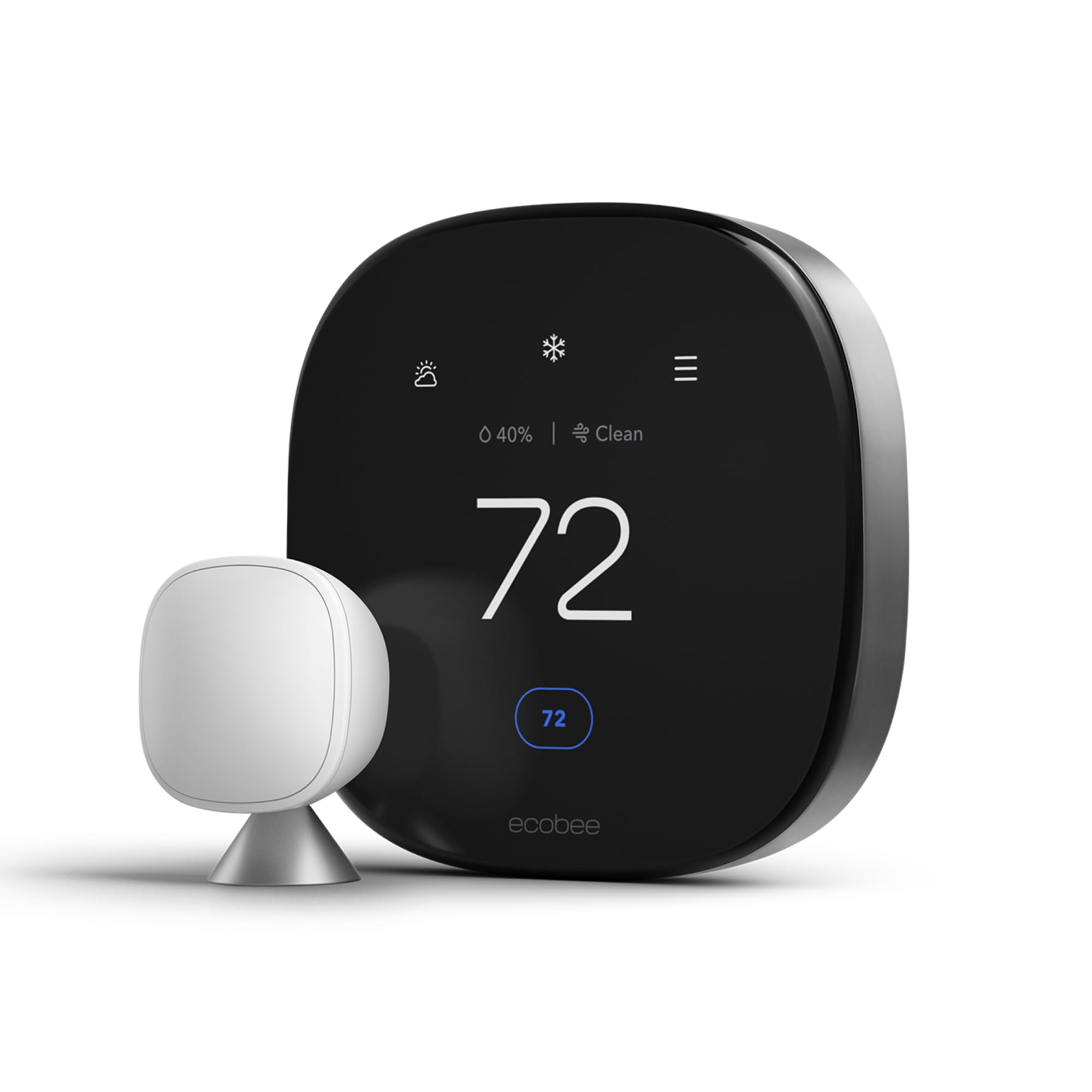
The ecobee Smart Thermostat Premium stands out in this list because its supplied title specifically identifies a smart sensor. That makes it the most natural option to investigate for a multi-story home where the temperature at the main thermostat does not represent the rooms people use most. The title also lists built-in Siri and Alexa support, Google Home compatibility, an air-quality monitor, and a live view from an ecobee Doorbell.
Those features may be attractive in a connected home, but the available evidence does not provide detailed installation requirements, sensor behavior, HVAC compatibility, or what is included in the package. Verify those points before purchase, particularly if you have a heat pump, multiple stages, separate zones, or a preferred voice platform.
Best for: Households that want to investigate room-aware comfort and already use, or plan to use, ecobee-connected devices.
Tradeoff: The supplied information is limited, so compatibility and installation research is especially important.
3. Vine TJ-919T-V2 — Best for a large touchscreen and flexible scheduling

The Vine TJ-919T-V2 offers a 4.3-inch touchscreen with a nightlight, making it a reasonable choice for someone who wants the wall control to be easy to see after dark. It supports seven-day scheduling with eight periods, Auto Home/Away mode, remote control through the Vine or Smart Life app, and voice control through Alexa and Google Home.
Its compatibility notes cover several 24-volt systems, including conventional systems, heat pumps with auxiliary or emergency heat, and heat- or cool-only systems. However, the supplied evidence is explicit that a C-wire is required for all Vine thermostats. The product also lists fan control, geofencing, weather forecasting, data encryption, and Wi-Fi auto-reconnect.
Best for: A buyer who prioritizes a visible touchscreen, detailed weekly schedules, and Alexa or Google Home control.
Tradeoff: The C-wire requirement can rule it out for some existing installations. Use the compatibility check before buying and confirm the wiring at every thermostat location.
4. ecobee Smart Thermostat Enhanced — Best for a simpler ecobee smart-home entry

The ecobee Smart Thermostat Enhanced is described as a programmable Wi-Fi thermostat with compatibility for Siri, Alexa, and Google Assistant. It is also identified as ENERGY STAR certified. That combination makes it worth considering for a multi-story household that wants app-based scheduling and voice control without selecting the Premium model.
The supplied evidence does not specify whether this package includes a remote sensor, nor does it provide HVAC-system or wiring details. Those omissions matter in a multi-story house: do not assume that the Enhanced model offers the same sensor-related capabilities as the Premium model. Check the current installation documentation against your system and decide whether the main thermostat location gives you representative temperature information.
Best for: Smart-home users seeking programmable Wi-Fi control with Siri, Alexa, or Google Assistant compatibility.
Tradeoff: The available product evidence does not establish room-sensor inclusion or detailed system compatibility.
5. Honeywell Home X7S — Best for occupancy features and Matter connectivity

The Honeywell Home X7S combines a customizable 4.3-inch display with occupancy and presence detection. Its Auto Away feature can adjust settings when enabled, which may help reduce unnecessary heating or cooling while the home is empty. It also offers humidity monitoring and indoor-air-quality features, although additional HVAC equipment or accessories may be required for some air-quality functions.
The X7S is Matter certified and works with Amazon Alexa, Google Assistant, and Apple Home. It is listed as ENERGY STAR certified and may be relevant to homeowners investigating energy-program participation or rebates; eligibility depends on the program and location, so verify the details rather than assuming a rebate applies.
Compatibility is clearly defined in the supplied evidence: it works with up to three heat/two cool heat-pump systems with electric backup or two heat/two cool conventional systems, plus hot-water heat and forced-air gas, oil, or electric systems. It does not work with 120-to-240-volt electric baseboard heat. A C-wire is required, although the package includes a voucher for a Honeywell Home C-Wire Adapter if the system does not already have one. It supports 2.4- or 5-GHz Wi-Fi with compatible 802.11 wireless standards.
Best for: A homeowner who wants occupancy-based control, humidity information, and broad smart-home interoperability.
Tradeoff: It has more compatibility conditions to check, including the C-wire requirement and the exclusion of electric baseboard heat.
How to choose the right thermostat before buying
- Identify the HVAC type. Photograph the existing wiring and thermostat terminals, then compare them with the manufacturer’s compatibility guide. Heat pumps, auxiliary heat, boilers, and multi-stage equipment need particular attention.
- Check for a C-wire. Never rely on the thermostat’s appearance alone. Confirm whether your system has a common wire and whether an approved adapter is available.
- Decide whether you need room sensing. If the upstairs hallway is the problem, prioritize a model and accessory setup that can account for the rooms you actually occupy.
- Match your smart-home platform. Verify support for Alexa, Google Home, Apple Home, Siri, Matter, or another platform before committing.
- Use schedules conservatively. Set realistic occupied and away periods, then adjust them after observing comfort and energy use. Extreme setbacks may be unsuitable for some equipment or occupants.
FAQ
Can one smart thermostat fix uneven temperatures between floors?
Usually not by itself. It can improve schedules and control, while sensors, balancing, insulation, ductwork, or a professionally designed zoning system may be needed for persistent floor-to-floor differences.
Which option is easiest to investigate for a DIY installation?
The Sensi ST55 includes a built-in level, app instructions, and a common-wire-not-required-in-most-applications claim. Still, turn off power and verify compatibility before removing the old thermostat.
Are smart thermostats guaranteed to lower energy bills?
No. They can make efficient schedules and away settings easier to follow, but actual energy use depends on the home, HVAC equipment, weather, insulation, and temperature settings.
 ✓