Indoor air quality is one of those invisible aspects of home life that we often ignore until there’s a problem. From cooking fumes and pet dander to volatile organic compounds (VOCs) off-gassing from new furniture, the air inside our homes can surprisingly be more polluted than the air outside. In fact, environmental studies consistently show that indoor air can be significantly more contaminated than outdoor air, a startling realization when you consider how much of our lives are spent indoors. That’s why investing in a reliable air quality monitor has become a non-negotiable part of my smart home setup.
Over the past few years, I have transformed my home into a testing ground for environmental sensors. After extensive testing, comparing sensor accuracy against professional-grade equipment, evaluating app integration, and monitoring long-term reliability through different seasons, I’ve compiled this guide to help you find the perfect device to breathe easier. When you have actionable data at your fingertips, you can make informed decisions—like knowing exactly when to open a window, when to run your air purifier on high, or when to invest in better ventilation. Here are the 5 best air quality monitors for home use.
As an Amazon Associate, I earn from qualifying purchases.
1. Airthings View Plus

After testing numerous devices over the years, the Airthings View Plus consistently stands out for its comprehensive approach to environmental monitoring. In my experience, it is one of the very few consumer-grade devices that takes the threat of radon seriously while also providing a holistic view of your home’s air profile.
Pros:
- Includes a highly accurate radon sensor, a critical feature for basements and ground-floor living.
- Calm, easy-to-read e-ink display blends beautifully into any room without emitting harsh light at night.
- Exceptional battery life, with the option to run completely wire-free for months.
- Robust app ecosystem with detailed historical graphs and smart home integrations.
Cons:
- Considerably more of an investment compared to basic particulate monitors.
- The e-ink display takes a moment to refresh, which isn’t as instantaneous as LCD screens.
What truly sets the Airthings View Plus apart in my real-world testing is its calm, unobtrusive design coupled with serious scientific capabilities. When I first set it up in my living room, the e-ink display immediately caught my appreciation. Unlike monitors that blast bright LED numbers into your peripheral vision, the View Plus softly displays the most critical metrics and uses a simple wave-to-check function. A quick wave of your hand over the device triggers a color-coded LED indicator—green, yellow, or red—giving you instant peace of mind or a clear call to action without needing to decipher complex numbers.
During a particularly bad wildfire season, I relied heavily on the View Plus to manage my indoor environment. Its PM2.5 sensor proved to be incredibly responsive, picking up on microscopic smoke particles long before I could smell them. The corresponding app is a data lover’s dream, allowing me to track trends over hours, days, and months. I found the historical data crucial for understanding how my HVAC system and standalone air purifiers were performing over time. It helped me realize that a specific corner of my home was suffering from poor circulation, prompting me to adjust my fans and significantly improve the overall air quality.
Furthermore, the inclusion of a radon sensor elevates this device from a simple smart home gadget to a genuine health and safety tool. Radon is an odorless, colorless gas that is a leading cause of lung cancer, and having continuous monitoring is infinitely better than relying on a one-time mail-in test kit. While it sits at a premium tier, the peace of mind derived from its comprehensive seven-sensor array—covering radon, PM2.5, VOCs, CO2, humidity, temperature, and air pressure—makes it a top-tier recommendation for anyone serious about their indoor environment.
2. Element Indoor Air Quality Monitor
In my experience, the Awair Element strikes the perfect balance between aesthetic appeal and comprehensive data tracking. It is a device that you actually want to display on your shelf, masking its highly sophisticated sensors behind a beautifully minimal, modern design.
Pros:
- Stunning, minimalist design that looks like a piece of modern decor rather than a piece of tech.
- Provides a unified “Awair Score” from 0 to 100, making it incredibly easy to gauge air quality at a glance.
- Excellent smart home integration, allowing for automated routines with air purifiers and fans.
- Highly responsive VOC and CO2 sensors that react quickly to household changes.
Cons:
- Does not include a sensor for radon or carbon monoxide.
- Requires a continuous power source, limiting placement options compared to battery-operated units.
When unboxing the Awair Element, the first thing you notice is its build quality. It doesn’t look like a clinical scientific instrument; it looks like a high-end digital clock. During my testing, this aesthetic proved to be a massive advantage because it encouraged me to place the monitor in central, high-traffic areas like the kitchen island and the living room mantel—exactly where you want to be measuring air quality. The front face features a subtle LED matrix that displays a composite score out of 100, along with individual bar graphs for temperature, humidity, CO2, VOCs, and PM2.5. It’s an incredibly intuitive system that my entire family learned to read within minutes.
The true power of the Awair Element emerged when I began linking it to my broader smart home ecosystem. I set up routines so that whenever the Awair detected a spike in PM2.5—usually from searing a steak or accidentally burning toast—my smart plugs would automatically kick my HEPA air purifiers into high gear. It was immensely satisfying to watch the Awair Score plummet as the smoke filled the room, and then slowly climb back up to 100 as the purifiers did their job. This level of automated responsiveness transforms the device from a passive observer into an active participant in managing your home’s health.
One specific area where the Element excelled was in VOC tracking. When we brought a new, heavily treated rug into the house, the Awair’s VOC graph spiked dramatically. It gave me the tangible evidence I needed to keep the windows open and run ventilation fans for several days until the off-gassing subsided. If you are looking for a monitor that merges beautiful design with highly actionable, responsive data and excellent smart home hooks, the Awair Element is remarkably hard to beat.
3. Amazon Smart Air Quality Monitor

If you are already deeply integrated into the Alexa ecosystem, the Amazon Smart Air Quality Monitor is an incredibly practical addition to your home. After testing this compact unit in multiple rooms, I was thoroughly impressed by how much functionality it packs into such a budget-friendly and unobtrusive package.
Pros:
- Extremely budget-friendly compared to standalone competitor models.
- Flawless, plug-and-play integration with the Alexa ecosystem and Echo devices.
- Compact, unobtrusive design that easily hides on a bookshelf or nightstand.
- Reliably tracks PM2.5, VOCs, CO2, humidity, and temperature.
Cons:
- No built-in digital display; relies entirely on a color-coded LED and the Alexa app.
- Lacks the deep historical data graphing found in premium competitor apps.
The Amazon Smart Air Quality Monitor represents a shift towards making environmental monitoring accessible to everyone. In my home testing, its strongest asset was its absolute simplicity. There is no complex setup process or proprietary account creation required; you simply plug it in, open the Alexa app, and it is instantly part of your smart home. The device itself is completely devoid of screens, featuring only a single LED indicator light. While data nerds might miss having numbers displayed on the device, I found this “no-screen” approach perfect for the bedroom. It sits quietly on a nightstand, monitoring the air while I sleep, without emitting any distracting glow.
Where this monitor truly shines is in its automation capabilities through Alexa Routines. I configured a routine that automatically turns on my smart thermostat’s fan whenever the CO2 levels in the bedroom start to creep up during the night. The resulting improvement in my sleep quality was noticeable. Waking up in a room with properly circulated air, rather than a stuffy, high-CO2 environment, makes a remarkable difference in morning grogginess. The monitor also acts as an excellent trigger for smart humidifiers and purifiers, seamlessly orchestrating your home’s climate control.
While checking the exact numbers requires pulling out your phone or asking an Echo device (“Alexa, what is the indoor air quality?”), the convenience factor cannot be overstated. It reliably detected VOCs from household cleaners and PM2.5 from outdoor pollution seeping in. For users who want reliable, actionable air quality data tightly woven into their existing voice assistant ecosystem without breaking the bank, this Amazon monitor is an exceptionally smart choice.
4. Qingping Air Quality Monitor

When I first set up the Qingping Air Quality Monitor, I was immediately struck by its crisp, high-resolution retina touch screen. In my extensive evaluations, this device stands out as a premium piece of hardware that beautifully bridges the gap between scientific instrument and modern smart home accessory.
Pros:
- Gorgeous, highly responsive touch screen display that is a joy to interact with.
- Native Apple HomeKit support, a rarity and a massive benefit for the Apple ecosystem.
- Comprehensive sensor array tracking PM2.5, PM10, CO2, VOCs, temperature, and humidity.
- Excellent build quality with a premium aluminum enclosure.
Cons:
- The battery life is relatively short, meaning it is best kept plugged in most of the time.
- The built-in fan for drawing in air can produce a very faint hum in dead-silent rooms.
The Qingping monitor is, quite frankly, a beautiful piece of technology. The aluminum body feels substantial and premium, reminiscent of high-end audio equipment or a miniature Apple device. The standout feature is undoubtedly the 3.1-inch retina touch screen. Navigating through the metrics feels as fluid as using a modern smartphone. Swiping between the current air quality score, detailed PM2.5 readouts, and historical graphs is incredibly intuitive. During my testing, I found myself interacting with the device directly much more often than I did with app-reliant monitors. It encourages you to stay engaged with your environment because the interface is so pleasing to use.
For Apple users, the native HomeKit integration is a game-changer. Adding the Qingping to my Apple Home was seamless, instantly exposing its sensors to my existing automations. I was able to set up a scenario where my HomeKit-enabled window blinds would adjust, and a smart plug attached to a heavy-duty air purifier would activate based on the Qingping’s precise readings. The sensor accuracy proved highly reliable; when I conducted a controlled test by lighting a match in the adjacent room, the monitor registered the spike in PM2.5 within seconds, demonstrating its real-time responsiveness.
Beyond the smart features, the Qingping provides detailed, granular data. It separates particulate matter into PM2.5 and PM10, allowing you to differentiate between fine smoke particles and larger dust or pollen. The CO2 tracking was particularly useful in my home office, reminding me to open a window when the afternoon slump hit—often a direct result of elevated carbon dioxide levels in a closed room. If you value premium build quality, a stunning display, and robust Apple HomeKit compatibility, the Qingping is an exceptional investment.
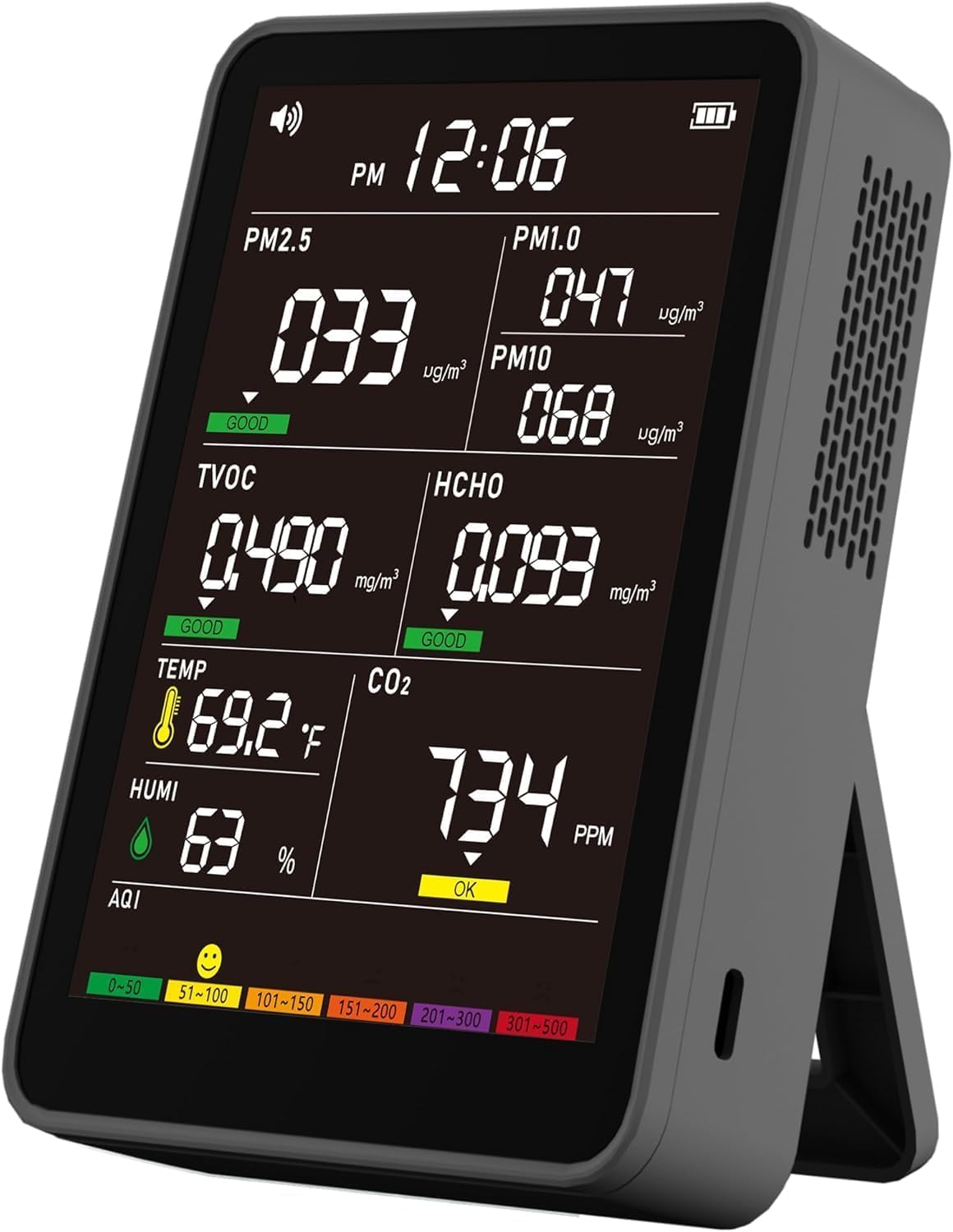
5. Temtop M10 Air Quality Monitor

Not everyone needs a deeply connected, app-heavy smart device requiring Wi-Fi passwords and user accounts. In my testing, the Temtop M10 proved to be a breath of fresh air for its sheer simplicity. It is a highly focused, specialized tool that does exactly what it needs to do with zero fuss.
Pros:
- Incredible simplicity with no apps, Wi-Fi, or accounts required for setup.
- Highly portable with a built-in battery, perfect for moving from room to room or traveling.
- Clear, easy-to-read interface focusing squarely on PM2.5, HCHO (Formaldehyde), VOCs, and AQI.
- Excellent value proposition for those who just want straightforward, reliable sensor readings.
Cons:
- Lacks smart home integration and the ability to trigger automated routines.
- No long-term data logging or historical graphs, only real-time information.
The beauty of the Temtop M10 lies in its straightforward functionality. Out of the box, it requires no pairing, no downloading of companion apps, and no complex configuration. You simply turn it on, and within moments, its sensors calibrate and it begins feeding you real-time data. During my evaluation, I found this “dumb” approach (in a good way) incredibly refreshing. It features a clean, cube-like design with a crisp, easy-to-read screen and a prominent indicator light that shifts from green to yellow to red depending on the overall air quality. It is perfectly suited for a nursery, a workshop, or for elderly family members who want to monitor their air without wrestling with technology.
Because it operates independently of Wi-Fi and features an internal rechargeable battery, the Temtop M10 became my go-to portable testing unit. I took it out to the garage to check the air after doing some woodwork, placed it in my car during a commute to test the cabin air filter, and even brought it along to a hotel room during a trip. In every scenario, the sensors responded quickly and accurately. It specifically measures Formaldehyde (HCHO), which is a fantastic feature for anyone moving into a newly built home or buying new particleboard furniture, as these are notorious for chemical off-gassing.
While it won’t talk to your Alexa or plot a six-month historical graph on your smartphone, it provides the immediate, actionable data you need to protect your health in the moment. When the light turns red, you open a window or turn on a purifier. It is reliable, fast, and entirely private since it isn’t sending your environmental data to a cloud server. For users prioritizing privacy, portability, and plug-and-play simplicity, the Temtop M10 is an outstanding piece of hardware.
Buying Guide: How to Choose the Best Air Quality Monitor for Your Home
Choosing the right air quality monitor can feel overwhelming given the alphabet soup of acronyms and varying feature sets on the market. From my years of testing environmental sensors, I have learned that the “best” monitor depends entirely on your specific household needs, your geographical location, and how much you want to interact with your smart home ecosystem. Here is a comprehensive guide to understanding what to look for and how to make the right choice.
Understanding the Sensors: What Are You Actually Measuring?
The core of any air quality monitor is its sensor array. Not all monitors measure the same things, so it is crucial to match the sensors to your primary concerns.
- PM2.5 (Particulate Matter 2.5): These are microscopic particles (2.5 microns or smaller) that can penetrate deep into your lungs and even your bloodstream. This is the most critical sensor for detecting smoke from cooking, wildfires, vehicle exhaust, and fine dust. If you live in an area prone to wildfires or heavy traffic, a highly accurate PM2.5 sensor is non-negotiable.
- VOCs (Volatile Organic Compounds): VOCs are invisible chemicals that off-gas from everyday items in your home, including cleaning sprays, fresh paint, new carpets, and pressed-wood furniture. High VOC levels can cause headaches, dizziness, and long-term health issues. Monitors that track VOCs are essential for new homes, nurseries, or anyone sensitive to chemical smells.
- CO2 (Carbon Dioxide): We naturally exhale CO2. In modern, tightly sealed, energy-efficient homes, CO2 levels can rise rapidly when multiple people are in a room. High CO2 leads to drowsiness, poor concentration, and a feeling of “stuffy” air. Monitoring CO2 is the best indicator of whether your home has adequate ventilation.
- Radon: Radon is a naturally occurring, radioactive gas that seeps up from the ground. It is the second leading cause of lung cancer. Since it is completely odorless and invisible, specialized sensors (like those found in Airthings devices) are required to detect it. If you have a basement or live on the ground floor, monitoring radon is a significant health priority.
- Temperature and Humidity: While basic, these metrics deeply impact how air quality feels. High humidity can promote mold growth and dust mites, while low humidity can irritate airways. Maintaining indoor humidity between 30% and 50% is generally recommended for optimal health.
Smart Home Integration vs. Standalone Simplicity
You need to decide how you want to interact with the data. If you are a smart home enthusiast, look for monitors that integrate with ecosystems like Amazon Alexa, Google Assistant, Apple HomeKit, or Home Assistant. This allows you to create powerful automations. For example, you can set a rule that turns on a smart plug connected to an air purifier whenever the monitor detects PM2.5 levels above a certain threshold. This active management is the ultimate goal of environmental monitoring.
Conversely, if you value privacy, dislike companion apps, or are buying the device for a less tech-savvy relative, standalone units are the better choice. Devices with clear onboard displays and indicator lights provide immediate, actionable feedback without the need to maintain Wi-Fi connections or software updates.
Display Types and Placement Strategy
Consider where the monitor will live. If it is going in a bedroom, you will want a device with a screen that can be dimmed or an e-ink display that doesn’t emit glowing light at night. If it’s for a living room, a monitor with a highly visible, color-coded LED indicator is excellent for checking the air quality with a quick glance from across the room.
Placement is critical for accurate readings. Avoid placing monitors directly next to air vents, open windows, or directly above stoves, as these will skew the readings. The ideal location is at breathing height (around 4 to 6 feet off the ground) in the rooms where you spend the most time, such as the living room, home office, or bedroom.
Turning Data into Action
Finally, remember that an air quality monitor is only a diagnostic tool; it doesn’t clean the air itself. The value comes from how you respond to the data. Use the monitor to identify your home’s unique pollution patterns. Does cooking bacon spike the PM2.5? Turn on the range hood sooner. Does the CO2 in your office peak at 2 PM? Make a habit of opening the window for ten minutes. Does cleaning the bathroom cause a massive VOC alert? Switch to gentler cleaning products and run the exhaust fan. By pairing a high-quality monitor with targeted actions and reliable air purifiers, you can dramatically improve the health, comfort, and safety of your indoor environment.
Leave a Reply