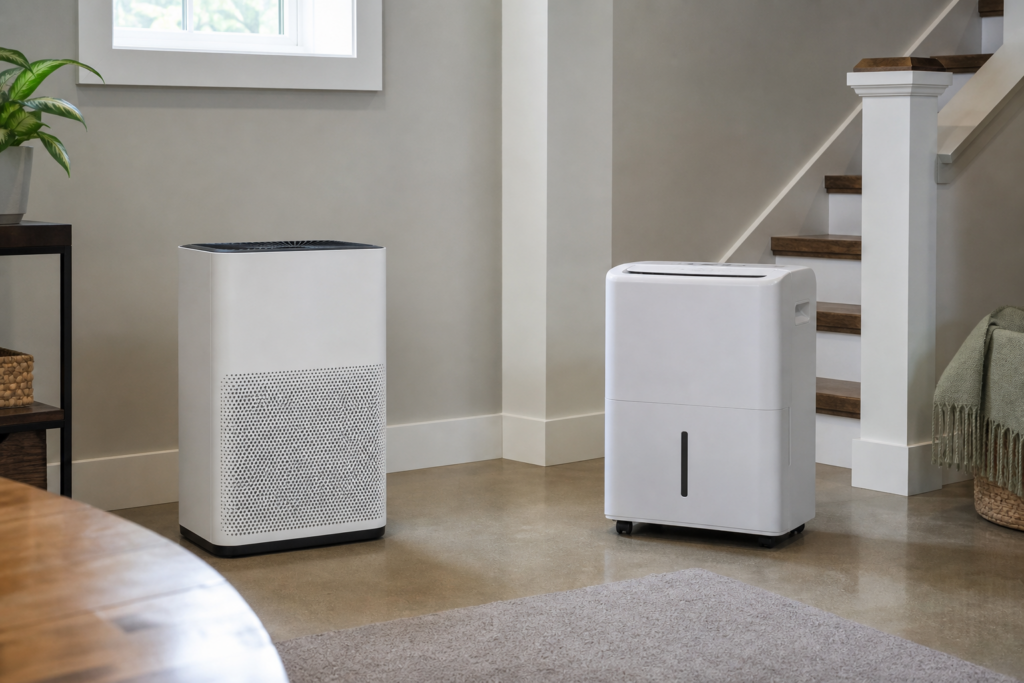
Air purifiers and dehumidifiers are both marketed as ways to make indoor air more comfortable, but they solve different problems. An air purifier moves room air through filters to capture airborne particles. A dehumidifier removes water vapor from the air and collects or drains the resulting water.
Choose an air purifier when your main concern is airborne dust, pollen, pet dander, smoke particles, or similar contaminants that a suitable filter can capture. Choose a dehumidifier when the room feels damp, condensation forms, or measured relative humidity remains high. Some homes benefit from both appliances because filtration and moisture control are separate jobs.
Neither device replaces basic source control. A purifier cannot repair a water leak, and a dehumidifier cannot capture smoke particles the way a particle filter can. Understanding the difference helps you avoid buying the wrong appliance for the symptoms you notice.
What an Air Purifier Does
An air purifier uses a fan to pull surrounding air into the unit. A pre-filter may catch hair and larger debris, while a pleated particle filter captures smaller material suspended in the air. Some models add activated carbon to reduce certain odors and gases, although the amount and effectiveness of carbon vary.
The purifier does not deliberately cool, heat, humidify, or dry the room. Any slight change in comfort usually comes from air movement rather than a meaningful change in temperature or moisture. Its primary job is to reduce specific airborne contaminants as air repeatedly passes through the filter.
- Airborne dust and fine particles
- Pollen and some other allergens
- Pet dander while it remains airborne
- Smoke particles when the filter and airflow are appropriate
What a Dehumidifier Does
A dehumidifier draws moist air across a cold surface so water condenses and collects in a tank or flows through a drain hose. By reducing relative humidity, it can make a damp basement, laundry area, or bedroom feel less clammy and can discourage conditions that support mold and dust mites.
A dehumidifier is not a substitute for fixing leaks, drainage problems, or water intrusion. It can manage moisture already in the air, but a continuing source may overwhelm the machine and damage the building. Persistent dampness, staining, or musty odors should prompt an inspection for the underlying cause.
- High measured relative humidity
- Condensation on cool windows or pipes
- A damp or clammy feeling
- Slow-drying laundry or surfaces
- Moisture-prone basements and lower levels
The Main Difference: Particles vs. Moisture
The easiest way to choose between the two appliances is to identify whether the problem is material floating in the air or excess water vapor. Dust, pollen, dander, and smoke are particles. Humidity is invisible moisture expressed as a percentage of the maximum water vapor the air can hold at a given temperature.
The problems can overlap. High humidity may encourage biological growth and make some allergens more troublesome, while a purifier may capture a portion of the resulting airborne material. Even so, filtering the air does not lower humidity, and removing moisture does not provide high-efficiency particle filtration.
When an Air Purifier Is the Better Choice
An air purifier is generally the more relevant appliance when indoor humidity is already in a comfortable range but airborne particles remain a concern. It is also useful when outdoor smoke or pollen enters the home, provided doors and windows are managed and the unit is properly sized for the room.
Look for a model with published airflow information and a filter suited to the particles you want to address. Room-size marketing can be inconsistent, so compare the Clean Air Delivery Rate when available. A machine that moves too little air may run normally yet take a long time to change conditions in a large space.
When a Dehumidifier Is the Better Choice
Choose a dehumidifier when a hygrometer repeatedly shows high humidity or when moisture symptoms appear. Basements often need dehumidification in warm weather because cooler foundation surfaces can cause humid air to condense. Bathrooms and kitchens usually rely first on exhaust ventilation, but nearby rooms may still need moisture control.
Capacity matters. A small unit may fill its tank frequently without bringing a damp space under control. Consider the room area, severity of moisture, operating temperature, drainage option, and energy use. In a cold basement, confirm that the model is designed to operate at the expected temperature.
Can You Run an Air Purifier and Dehumidifier Together?
Yes. The two appliances can operate in the same room because they perform different functions. A dehumidifier manages water vapor, while the purifier captures particles. Using both can make sense in a damp room that also contains dust, pet dander, or airborne particles from an earlier moisture problem.
Give both machines adequate clearance and avoid directing a strong exhaust stream from one unit straight into the intake of the other. The dehumidifier often produces some heat, so allow air to circulate. Keep cords and drain hoses arranged safely, and avoid overloading a single outlet or extension device.
Which Appliance Helps With Musty Odors?
A musty odor often points to excess moisture or material that has remained damp. A dehumidifier may reduce the conditions that allow the odor source to persist, but it will not remove wet drywall, hidden growth, or contaminated carpet. The source still needs to be found and corrected.
An air purifier with a meaningful carbon stage may reduce some odor molecules in the air, but it can only treat what passes through the media. Using a purifier to mask a moisture problem is not a lasting solution. Address water first, clean or remove damaged material, then use filtration as an additional measure.
How to Decide Using Simple Measurements
Start with a basic hygrometer and observe the room over several days. Relative humidity changes with weather, temperature, showering, cooking, and HVAC operation. A single reading immediately after a shower or open-window period may not represent normal conditions.
If moisture is acceptable but fine-particle readings or obvious airborne sources remain, investigate filtration. If humidity is consistently high, prioritize the moisture source and dehumidification. When both measurements are poor, use the appropriate appliance for each problem rather than expecting one machine to perform both jobs.
Common Buying Mistakes to Avoid
Do not choose solely by the largest room-size number printed on the box. Compare airflow for purifiers and moisture-removal capacity for dehumidifiers. Also consider replacement-filter cost, tank size, drainage, noise, and the fan setting you can tolerate during daily use.
Avoid devices that promise to solve every air-quality problem without explaining the mechanism. A practical setup starts with ventilation, leak repair, cleaning, source control, and appropriate HVAC maintenance. Portable appliances can support those measures, but they cannot replace them.
Frequently Asked Questions
Will an air purifier lower humidity?
No. A standard air purifier circulates and filters air but does not remove a meaningful amount of water vapor. Use ventilation, air conditioning, or a dehumidifier for moisture control.
Will a dehumidifier remove dust?
A small amount of debris may collect on its intake filter, but a dehumidifier is not designed as a high-efficiency particle cleaner. Its main purpose is moisture removal.
Which is better for a basement?
It depends on the problem. A damp basement usually needs leak correction and dehumidification. If the space also has airborne dust or allergens, an air purifier can be an additional appliance.
Which one helps with allergies?
A purifier with an appropriate particle filter may reduce airborne allergens. Humidity control can also matter when the room is too damp, but a dehumidifier does not replace particle filtration.
Do I need both appliances in a bedroom?
Only if measurements and conditions justify both. Use a hygrometer to evaluate moisture and consider a purifier when there is a specific airborne-particle concern. Avoid adding appliances without identifying the problem first.
Final Thoughts
An air purifier and a dehumidifier are not competing versions of the same appliance. The purifier addresses particles moving through the air, while the dehumidifier controls excess water vapor. Choose according to the problem you can observe or measure.
If your home has both airborne particles and persistent dampness, the appliances can work together. Correct placement, realistic sizing, routine maintenance, and repair of underlying pollution or moisture sources will matter more than simply running another machine.
Leave a Reply